
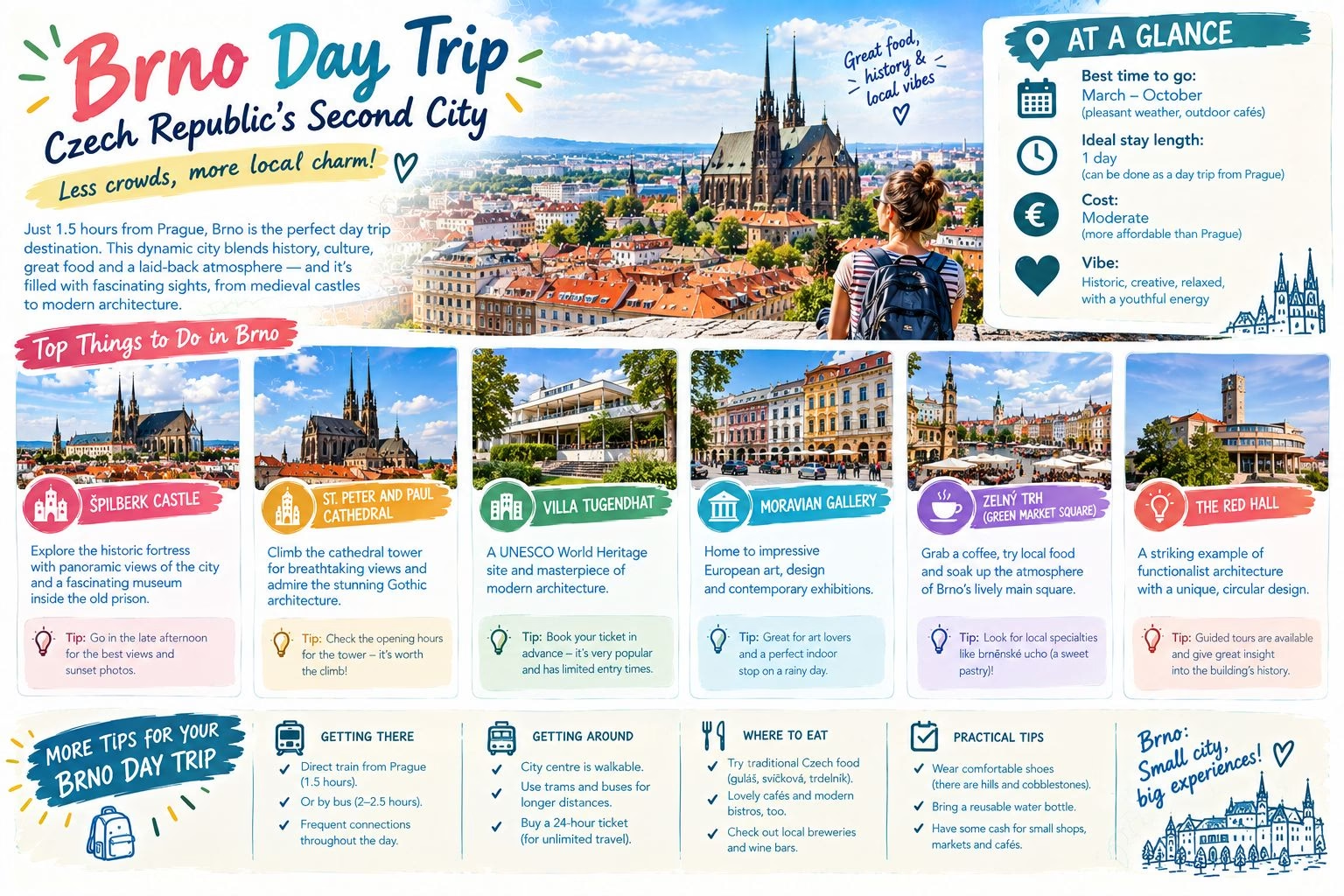
Brno is the Czech Republic’s second city, the capital of Moravia, and one of Central Europe’s most underrated urban destinations. A city of approximately 380,000 people with a major university, a vibrant student culture, the country’s most significant Functionalist architecture heritage, and a wine culture quite different from the beer-dominant culture of Bohemia, Brno rewards visitors who give it time beyond the day-trip minimum. The train journey from Prague is 2 hours 20 minutes by fast train (IC or Eurocity); the city is well worth an overnight stay.
Getting There from Prague
By train (recommended): IC or EC trains from Praha hlavní nádraží to Brno hlavní nádraží. Journey: 2 hours 20 minutes on the fast services. RegioJet also serves this route at competitive prices. Trains run frequently throughout the day; no advance booking required except on the most popular departures at peak travel times. Cost: CZK 180 to 320 single depending on service and booking timing. From Brno main station, the historic centre is a 10 to 15 minute walk.
By bus (FlixBus): Direct buses from Prague Florenc to Brno; journey approximately 2.5 to 3 hours. Slightly slower than the train but often cheaper at late booking.
Špilberk Castle
The castle above Brno, originally built in the 13th century as a royal Gothic fortress and later converted to a Habsburg prison, is the most visited attraction in the city. The castle’s reputation derives from its use as the most feared prison in the Habsburg Empire during the 18th and 19th centuries, where Italian carbonari, Polish revolutionaries, and Czech patriots were held in the infamous casemates (underground dungeons). The Baroque castle visible today was restored after the castle’s prison function ended; the city museum now occupies the upper buildings and the casemates are accessible by guided tour.
The view from the castle terrace over the Brno city centre, with the Cathedral of Sts Peter and Paul visible on the facing hill, is one of the better urban panoramas in the Czech Republic.
Villa Tugendhat
The most internationally significant building in Brno is the Villa Tugendhat, designed by Mies van der Rohe and completed in 1930. The villa, built for a wealthy Brno Jewish family, is one of the canonical works of modernist architecture: the open-plan living area on the lower floor, with its floor-to-ceiling glass walls that can be lowered into the floor, the onyx stone dividing wall, and the curved macassar ebony wood partition are elements that appear in every survey of 20th-century architecture. The house was inscribed as a UNESCO World Heritage Site in 2001.
Entry is by timed guided tour only; advance booking is essential (tours sell out weeks in advance for popular periods). Book at tugendhat.eu. Entry approximately CZK 350. The tour takes approximately 1 hour.
The Ossuary (Brněnská kostnice)
Discovered during construction work beneath the Church of St James in the old town in 2001, the Brno Ossuary is the second-largest ossuary in Central Europe after the Paris Catacombs. Approximately 50,000 human remains from the 17th to 19th centuries are preserved in the underground space below the church. The ossuary was opened to visitors in 2012 after an extensive archaeological and conservation project. Entry approximately CZK 160; less well-known than the Kutná Hora Bone Church but equally extraordinary in its specific character.
The Functionalist Architecture Trail
Brno has the largest concentration of 1920s and 1930s Functionalist (Modernist) architecture in the Czech Republic. The city was an industrial and cultural centre during the First Republic period (1918 to 1938) and attracted both Czech and international architects. Beyond the Villa Tugendhat, the Moravian Trade Fair complex (Brněnské výstaviště), the Avion Hotel (the first curtain-wall building in Central Europe), and the workers’ housing colonies (Nový dům housing estate) constitute one of the most significant early Modernist ensembles in Central Europe. The Brno architecture guide published by the Brno City Museum is the best companion for a self-guided architectural walk.
Extending to Moravian Wine Country
Brno sits at the edge of South Moravia, the Czech Republic’s wine region, and an overnight in Brno is the natural base for reaching it. Mikulov, a walled wine town with its own castle above the Pálava hills, and Valtice, centre of the Lednice-Valtice cultural landscape (a UNESCO-listed complex of chateaux, parkland, and vineyards), are both approximately an hour from Brno by car or bus. Neither works well as a same-day add-on to the Brno sightseeing above; they are better treated as a separate half or full day for visitors who have built an overnight into their Brno plans.
Related: Day Trips Hub | Beer and Food: Czech Wine | Plan Your Trip | Expat and Nomad Hub