
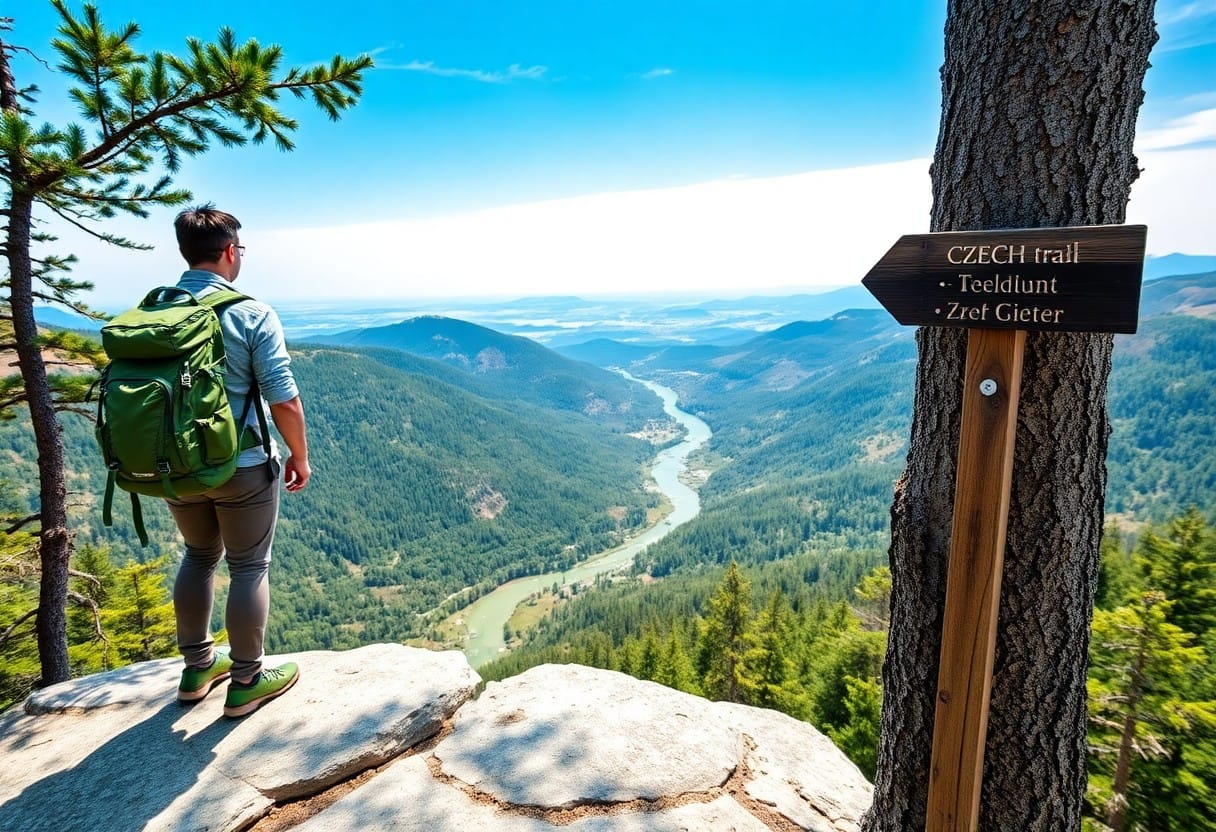
Nature in Czechia gives you varied hiking from gentle Bohemian forests to rugged Krkonoše ridges; well-marked trails and frequent shelters make solo routes accessible, but you must plan for sudden mountain storms, dense fog and steep, slippery terrain, carry a map and phone, and adjust your pace to daylight; efficient public transport and hospitable mountain huts let you combine multi-day treks with safe exit points while enjoying dramatic rock formations, deep forests and regional culture.
Types of Hiking Trails in Czechia
| Waymarked footpaths | Short connectors (1-10 km), color-coded blazes for orientation, common around towns and tourist hubs. |
| Mountain ridge trails | Exposed routes on ridgelines such as the Krkonoše and Jeseníky-often rocky, with panoramic views and variable weather. |
| Long-distance routes | Multi-day red-marked trails, spanning 50-200+ km; you can find logistics-friendly stages with huts and train links. |
| Nature-reserve loops | Boardwalks and short loops in protected areas like peat bogs and gorges; strict seasonal closures may apply. |
| Educational / family trails | Marked themed paths with signage, suitable for casual day hikes and wildlife observation. |
- Waymarked color system (red = long, blue = medium, green/yellow = local)
- Elevation ranges from flat river valleys to 1,603 m Sněžka in Krkonoše
- Seasonality matters: expect snowpack above ~900-1,000 m in winter
National Parks
You will find four official National Parks that shape the toughest and most rewarding routes: Krkonoše with Sněžka (1,603 m) and exposed granite ridges, Šumava with extensive peat bogs and long forest tracks, Bohemian Switzerland with sandstone arches like Pravčická brána and steep canyon trails, and Podyjí which offers tight river-valley paths and vineyard-adjacent walks. Expect well-maintained waymarks, mountain huts or refuges in Krkonoše, and park rules that protect habitats-staying on paths is enforced in sensitive zones.
You can use local visitor centers to plan multi-stage treks and check seasonal trail closures; for an overview of notable nature areas and visitor ratings consult THE 10 BEST Czech Republic Nature & Wildlife Areas (2026). Strong weather shifts above 1,000 m and narrow canyon sections in Bohemian Switzerland mean you should carry a map, headlamp, and layered insulation, and be prepared for rapid visibility changes.
Regional Hiking Routes
Regional networks are where you will spend most of your solo hiking time: the color-coded system connects towns, shelters and bus/train stops so you can tailor hikes from 3 km loops to long sections of 80-150 km without committing to alpine logistics. Examples include ridge traverses in the Beskydy and Jeseníky, valley circuits in the Bohemian-Moravian Highlands, and coastal-like river trails along the Dyje; many local routes have interpretive panels and seasonal farms where you can resupply.
Trail difficulty varies: rocky ridgelines and steep ascents can be physically demanding, river valleys may flood in spring, and some forest tracks become navigationally tricky after storms-you should check recent trail reports at regional tourist offices or online maps before setting out.
Thou should match route length to daylight, factor public-transport return options, and prioritize marked connectors if you plan to hike alone.
Types of Nature and Hiking Options
Choose from rugged mountain ranges, dramatic sandstone towns, dense forests, karst caves and quiet river valleys when planning your route in Czechia. You will find an extensive, well-marked network-over 40,000 km of trails maintained by the KČT-that suits everything from short day loops to multi-day ridge hikes.
Many areas are very solo-friendly, with frequent trail junctions, shelters and public transport access; still, expect rapid weather changes above the tree line and seasonal hazards such as icy trails in winter or ticks in summer. You should plan gear and timing around specific locations: alpine ridges behave very differently from lowland reserve boardwalks, and some protected zones enforce restricted access to protect flora and fauna.
- National Parks – Krkonoše, Šumava, Podyjí, České Švýcarsko
- Nature Reserves – peat bogs, oxbow lakes, singular habitats
- Scenic Hiking Trails – marked circuits and long-distance routes
- Rock formations & viewpoints – Adršpach, Pravčická brána, Prachov Rocks
- Karst & caves – Moravian Karst, Macocha Abyss
| National Parks & Reserves | High-altitude ridges, peat bogs and strict protection zones; best for day-to-multi-day treks with marked shelters. |
| Mountain Ranges | Krkonoše (Sněžka 1,603 m) and Šumava offer ridgeline walks and winter routes-prepare for sudden weather shifts. |
| Sandstone & Rock Towns | Bohemian Switzerland and Adršpach provide short technical sections, ladders and exposed viewpoints-watch footing. |
| Forests & Lowlands | Třeboňsko peatlands and river valleys suit relaxed, wildlife-focused hikes and birdwatching circuits. |
| Karst & Cave Areas | Moravian Karst centers on the Macocha Abyss and show caves; combine surface trails with cave tours for variety. |
National Parks and Nature Reserves
You can base several solo itineraries around the four national parks: Krkonoše with alpine ridgelines and Sněžka (1,603 m), Šumava with extensive peatlands and cross-border trails, Podyjí as the smallest park (about 63 km²) with steep river gorge hiking, and České Švýcarsko (Bohemian Switzerland) famous for Pravčická brána and deep sandstone valleys. Trails here range from short viewpoint loops to demanding multi-day routes, and local info centres publish seasonal closures your route may need to respect.
When you hike in reserves, stick to marked paths to avoid disturbing sensitive habitats and to comply with park rules; fines and forced reroutes are enforced in some zones. Pay attention to signage about restricted access, fire bans and avalanche warnings in winter, and treat alpine weather as unpredictable-pack extra layers and a reliable map or offline GPS.
Scenic Hiking Trails
Many scenic trails are compact and intensely rewarding: for example, the loops through Adršpach-Teplice rock labyrinths typically run 3-6 km with narrow passages and ladders, while circuits around Prachov Rocks in Český ráj combine sandstone towers and castle ruins. The long-distance, color-marked network maintained by KČT makes it easy to link several scenic sectors into a multi-day route while relying on public transport to reach trailheads.
Specific highlights for you include the paved viewpoints and boardwalks in Šumava for low-impact walks, the exposed ridgeline approaches to Sněžka for a strenuous day hike, and the Macocha Abyss in the Moravian Karst with a dramatic sinkhole that drops roughly 138 m. Expect varying technical difficulty: some sandstone trails have steep drop-offs and require sure footing and care during wet conditions.
Any time you plan a scenic route, check local trail reports, download offline maps and carry at least water, a headlamp and a charged phone; these simple steps reduce risk and let you focus on the landscape.
Solo Travel Tips for Hiking
Plan your days with realistic distances and elevation: trails in Czechia are well marked but often steeper than signs imply, especially in the Krkonoše (Sněžka 1,603 m) and sandstone areas of Bohemian Switzerland. Pack layers, a refillable water bottle (carry at least 1.5-2 L for day hikes), a headlamp, and a basic first-aid kit; leave your route and estimated return time with someone you trust. Use public transport to reach trailheads when possible-many mountain villages are served by regional trains or buses-and factor in earlier sunsets in autumn and winter.
- solo travel: choose shorter loops on your first day to build confidence
- hiking: check elevation gain, not just distance
- trail markers: follow the KČT colored blazes and signpost times
Safety Precautions
Carry the EU emergency number 112 and know that mountain rescue operates in main ranges; you can call from a mobile even if reception is spotty. Expect rapid weather shifts above ~800-1,000 m-storms can bring heavy rain, lightning, and sudden temperature drops-so keep an insulating layer and waterproof shell accessible. If you hike in winter, pack traction devices and an ice axe where steep icy approaches exist, and check avalanche bulletins locally before heading into exposed terrain.
Trust your pace: add a 25-30% buffer to guidebook times for unmarked rests, photography, or steep sections. Treat wet sandstone and wooden boardwalks as slippery hazards, and avoid narrow ridge routes in high wind. Leave a digital copy of your ID and itinerary, and consider a portable battery pack because mobile coverage can be intermittent on remote ridgelines.
Navigation and Mapping
The national trail network is maintained by the Klub českých turistů (KČT) and uses four color-coded blazes (red, blue, green, yellow) with signposts showing distances and estimated times; these signposts appear at junctions and often include destination names in both Czech and German in border areas. Rely on Mapy.cz for Czech topographic detail and offline routing-its offline tiles and hiking-specific overlays outperform many generic map apps for local paths.
Always carry a paper map and a compass as backups: battery failure or app glitches happen. Download GPX tracks beforehand and test them on your device; for example, routes up to Sněžka typically feature several steep switchbacks and can involve ~800-900 m elevation gain depending on the start point, so check the elevation profile rather than just distance.
This Hiking Czech – Rick Steves Travel Forum has trip reports, GPX links, and recent condition notes you can cross-reference with Mapy.cz and KČT maps.
Tips for Solo Hikers
- solo hiking
- Czechia
- Bohemian Paradise
- trail safety
- packing list
Safety Precautions
You should always file a simple itinerary with a friend or your accommodation listing start and finish times and key checkpoints; if plans change, update them. Carry a charged phone and a 10,000 mAh power bank, know the EU emergency number 112, and check the Czech Hydrometeorological Institute (CHMI) forecast before you set out. If you’re planning routes in sandstone areas or popular day-trip zones, study the Bohemian Paradise Nature Reserve trails and local signage so you can avoid unmarked shortcuts and seasonal restrictions.
Stay on the marked red/blue/green/yellow trail markers used across Czechia, hike in daylight where possible, and be mindful of ticks (check your body and clothing after each hike). Bring a whistle and headlamp with at least 200 lumens for unexpected delays, and accept that mobile coverage can be patchy in valleys and high ridges-download offline maps like Mapy.cz and keep a small emergency bivvy for extended stops.
Essential Gear and Supplies
Use a ventilated daypack of 20-30 L for day hikes or 35-50 L for overnight trips; fit it so it sits close to your hips. Wear sturdy boots with ankle support and crampon-compatible soles if you’re in winter or rocky terrain, and layer clothing to handle a 10°C+ temperature swing above tree line. Carry 1.5-2 L of water per day for temperate conditions, plus high-energy snacks totaling roughly 500-1,000 kcal for a full hiking day.
Navigation and safety items should include a paper map and compass, a phone with offline GPS, a basic first-aid kit with blister care and tick tweezers, and a compact rain shell. Pack a headlamp, lighter or matches in waterproof packaging, and a lightweight emergency blanket; these items address the most common single-person incidents you’re likely to face.
Choose footwear and a pack that you’ve already broken in, prioritize waterproof breathable fabrics, and keep spare socks to avoid blisters. Any small step you take to double-check kit, weather, and route will reduce risk and let you enjoy the hike.
Step-by-Step Guide to Planning a Solo Hiking Trip
| Step-by-Step Guide to Planning a Solo Hiking Trip | |
| Choosing Your Destination | Choosing Your DestinationYou should match the region to your fitness and season: for alpine ridges and a summit day aim for the Krkonoše (Sněžka 1,603 m – common routes are 8-12 km one way from Pec or Špindlerův Mlýn), while Bohemian Switzerland suits sandstone scenery and shorter loops (Pravčická brána circuits of 3-8 km). If you want long, quieter multi-day routes pick Šumava where 20-30 km stages across peatlands and ridgelines are typical, or the Moravian Karst for mixed cave-and-forest day hikes. Check seasonal constraints: snow can linger above 1,000 m into May in the Krkonoše, and some paths become muddy or overgrown in late spring. Trails in Czechia use a clear painted-blaze system (red/blue/green/yellow); that network makes navigation easier, but also expect sudden weather shifts and icy sections above 1,000 m that increase risk. |
| Preparing Your Gear | Preparing Your GearChoose boots with ankle support and a stiff sole for rocky trails, and keep your daypack around 8-12 kg for single-day trips or 12-18 kg for multi-day treks. Pack layered clothing (base + insulating + shell), a waterproof jacket, headlamp (≥100 lumens), spare batteries, and a small first-aid kit. Navigation should include a paper map at 1:50,000 or 1:25,000, a compass, and Mapy.cz offline maps on your phone – local hikers rely on Mapy.cz for trail detail. Account for safety items: a power bank (10,000 mAh), whistle, repair kit, and either microspikes or crampons if you go above 1,000 m outside of summer. Note that wild camping is restricted in national parks like Šumava and Krkonoše; use official campsites or mountain huts and book in high season. For emergencies carry the EU emergency number 112 and know the coordinates of your nearest trailhead; if you plan remote sections consider a personal locator beacon or a SIM with local coverage because GSM can drop out in valleys and ridge sections. |
| Setting an Itinerary | Setting an ItineraryPlan realistic daily distances based on elevation: target 12-20 km per day on rolling terrain, reduce to 8-12 km if you expect 800-1,200 m of ascent. Mark clear bail-out points (villages, bus or train stations) every 8-15 km; Czech regional buses and trains frequently serve trailheads (for example Trutnov for Krkonoše, Děčín for Bohemian Switzerland, Český Krumlov for Šumava). Reserve mountain huts or guesthouses in advance during July-August when huts fill quickly, and build a rest day into multi-day trips to recover and check weather. Share your route and expected check-in times with a contact and include alternate exits so someone can act if you miss a check-in. Aim to avoid single-day plans exceeding eight hours of hiking without intermediate stops, and keep daily plans flexible so you can shorten a stage if weather turns bad or you sustain an injury. |
Step-by-Step Guide for Planning Your Trip
| Step | Details & Examples |
|---|---|
| Choose region | Pick based on travel time: Krkonoše (~2-3 hr from Prague) for alpine ridges and Sněžka (1,602 m), Bohemian Switzerland (~2.5 hr) for sandstone and Pravčická brána, Šumava (3-4 hr) for peat bogs and long ridges, Beskydy (east, 4-6 hr) for remote forests. |
| When to go | Spring-autumn for most trails; winter needs ice gear. Expect thunderstorms June-August; plan altitudes accordingly. |
| Daily distance | Target 10-20 km/day on moderate terrain; allow 400-800 m ascent/day if you cross mountains. |
| Transport | Use České dráhy trains and regional buses (IDOS planner). Budget 30-150 CZK for short regional hops; reserve evening returns in high season. |
| Accommodation | Options: mountain huts (horská chata), guesthouses, campsites. In peak summer, book 1-3 weeks ahead for popular trails. |
| Navigation & maps | Download offline maps (Mapy.cz, Komoot). Trails marked by colored stripes; distances posted in km. Carry a paper map for Šumava and higher ridges. |
| Safety | Carry a headlamp, spare layers, first-aid kit. Weather can change fast above 1,000 m; mobile signal can drop in deep valleys. Emergency number: 112. |
| Gear checklist | Hiking boots, rain jacket, 3L water capacity, power bank, trekking poles for steep descents, and microspikes if you go in winter. |
Choosing a Destination
You should match terrain to the type of solo trip you want: go to Krkonoše if you want exposed ridgelines and a clear summit objective like Sněžka (expect 2-6 hours round trips), choose Bohemian Switzerland for short, scenic loops under 10 km around Hřensko and Pravčická brána, or pick Šumava for multi-day solitude across bogs and long forest tracks where sections of 15-25 km between huts are common. If you plan to rely on public transport, prioritize regions with direct train or frequent bus links from Prague-Krkonoše and Bohemian Switzerland are the easiest; Beskydy requires longer travel but rewards you with fewer hikers.
Factor in season and your fitness: spring brings muddy trails and patchy snow above 800-1,000 m, while late summer can have intense thunderstorms requiring earlier starts. You can use concrete examples: a 3-day Krkonoše loop typically covers 35-45 km with around 1,000-1,500 m total ascent, whereas a 2-day Bohemian Switzerland itinerary might be 12-18 km with short, steep sections and easy public transport back to Hřensko.
Creating an Itinerary
You should build a day-by-day plan with realistic distances and time buffers: convert trail profiles into hiking hours using 4-5 km/hr on flat paths and add 1 hr per 300-400 m of ascent. Block out transport windows using the IDOS timetable-factor in 30-90 minutes for bus/train connections in rural areas so you don’t miss the last link back to town. Plan a rest day or a short loop mid-trip if you schedule 3+ consecutive walking days.
Reserve accommodations for nights after long days, and check opening hours of mountain huts-many close outside the main season. In high season, popular huts and guesthouses can fill well in advance: for a long weekend in July or August, secure bookings at least 7-14 days before departure. Keep an offline copy of reservations and emergency contacts, and note that huts often expect cash or local card payments only.
Before you leave, create contingency options: have alternate lower-elevation routes if storms hit, identify nearby bus stops or train stations you can divert to, and leave your daily plan with a trusted contact. Use Mapy.cz route exports or a printed route sheet showing trail blaze colors and kilometer markers so you can rejoin your route quickly if you need to shorten a day.
Factors to Consider When Hiking Alone
When you plan a solo trek in Czechia, focus on route length, average daily elevation gain, and access to public transport-many trailheads are reachable by train or bus within 30-90 minutes of major cities like Prague and Brno. Choose segments with known resupply points: mountain huts (chata) in the Krkonoše and Šumava ranges are typically spaced 8-15 km apart, while remote parts of Bohemian Switzerland can force 20+ km days with limited water sources. Carry a printed map and note that the national trail system uses color-coded markers (red for long-distance, blue/green/yellow for regional/local), which are repainted every 50-200 m.
Factor in cell coverage and emergency access: mobile signal can be intermittent above ~1,000-1,200 m, and dialing 112 connects you to emergency services; the Horská služba (mountain rescue) operates in higher ranges. Pack a basic first-aid kit, headlamp, and a lightweight emergency shelter if you plan exposed ridges where weather shifts rapidly.
- hiking
- solo travel
- Czechia
- terrain
- weather
- safety
Terrain and Difficulty Levels
You should match routes to your fitness and technical skill: expect easy forest tracks and paved sections in lowlands, moderate graded trails with sustained climbs (500-1,000 m gain per day) in foothills, and exposed rocky ridges or scree above 1,000 m that require sure footing. Examples: trails to Sněžka (1,603 m) from Pec pod Sněžkou climb ~1,100 m over 8-10 km and include steep stone steps and occasional packed snow into late spring.
Pay attention to surface type and exposure-sandstone gorges in Bohemian Switzerland have narrow ledges and laddered sections, while Šumava offers boggy boardwalks that slow pace and require waterproof boots. Strongly avoid unmarked shortcuts on steep slopes because loose scree, wet rock, and unprotected edges increase risk of falls and injury.
Weather Conditions
The climate in Czech hiking areas is continental with mountain microclimates: summers typically see daytime highs of 20-25°C in lowlands but can drop to 5-10°C above 1,000 m, and sudden thunderstorms are common in afternoons from June to August-storms can bring hail and lightning within 20-30 minutes. Winters deliver persistent snow above ~800-1,000 m; for example, Krkonoše often retains snowfields into May, so plan for potential snow travel even in late spring.
Wind and fog are frequent on exposed ridges; gusts of 70-100 km/h occur during frontal passages, reducing visibility to <100 m and making navigation by GPS or compass necessary. If you encounter rapidly dropping temperature or visibility, move to sheltered terrain, add insulation, and avoid riverbeds or ridge crests where lightning risk is higher.
Check local forecasts from the ČHMÚ and trail-status reports before you go, layer with a waterproof breathable shell plus an insulating mid-layer, and carry a thermometer or altimeter so you can monitor conditions as you ascend-a lightweight emergency bivvy and waterproof mitts can prevent hypothermia if weather turns unexpectedly.
Assume that you will verify the ČHMÚ forecast, inform someone of your itinerary, pack layered clothing and an emergency shelter, and expect mobile reception gaps above 1,000-1,200 m.
Factors to Consider for Solo Hiking
- Weather – rapid changes, microclimates between lowlands and mountains
- Terrain – trail surface, exposure, elevation gain
- Trail markers and navigation – KČT network and wayfinding
- Access and rescue – proximity to roads, Horská služba availability
- Seasonal hazards – snow, ice, summer thunderstorms
Weather Conditions
You will face strong variability across Czechia: lowland summer days often reach 20-25 °C, while mountain summits like Sněžka (1,603 m) sit several degrees cooler thanks to the standard lapse rate of about 6.5 °C per 1,000 m. In the Krkonoše and Šumava ranges gusts can spike and fog can roll in within an hour; wind gusts sometimes exceed 100 km/h during storms and winter temperatures above 1,000 m can drop below -20 °C. Thunderstorms are most common June-August and bring sudden heavy rain and hail, which makes exposed ridges and polymer-soled approaches dangerously slippery.
You should check forecasts from ČHMÚ or local mountain services the morning of your hike and again right before you set out; hourly updates matter. Layering with a breathable shell, an insulated midlayer for alpine starts below freezing, and carrying an emergency bivy or shelter reduces hypothermia risk when conditions change rapidly. If you hike in winter, check avalanche bulletins for higher alpine sites and inform Horská služba or a contact about your intended route and expected finish time.
Terrain and Difficulty Levels
Trails in Czechia range from flat river valleys and paved park paths to rocky ridges and peat-bog tracks; the national network maintained by KČT exceeds 40,000 km, so you can usually choose routes that match your fitness. Plan for grades: easy day loops are typically 0-10 km with minimal elevation, moderate routes run 10-20 km with ~300-800 m gain, and hard hikes exceed 20 km or involve >800 m gain and technical sections. Many long-distance red-marked trails link mountain huts and villages, while blue/green/yellow connectors create shorter options.
Footwear, poles, and gaiters change your ability to handle certain surfaces: boggy peat in parts of Šumava holds water and tears light soles, loose scree on ridge descents demands firm ankle support, and icy stone steps require crampons. Navigation is usually straightforward because of clear markers, but sections through dense forest or karst plateaus (e.g., Moravian Karst) can be disorienting after fog or snowfall. Emergency access varies: some alpine ridges are a long walk from the nearest road, increasing extraction time.
Choose a benchmark route when planning: an easy introduction is a 6-8 km loop in Český ráj through rock towns; a moderate challenge is the Podyjí ridge at ~15 km with ~500 m cumulative gain; a demanding solo alpine day is the ascent to Sněžka from Pec pod Sněžkou (~12-14 km roundtrip with ~900 m gain). Adjust pace to daylight-winter days may give you 8-9 hours of usable light-and factor in time for weather delays and navigation breaks. This guides you to match route, gear, and contingency plans to the specific Czech trail you plan to tackle.
Pros and Cons of Solo Hiking in Czechia
| Pros | Cons |
|---|---|
| Absolute freedom to set pace and itinerary – you can linger at a viewpoint or change plans on the fly. | Full responsibility for navigation and timing; you must plan routes, water, and resupply alone. |
| Access to a dense network of trails – there are over 40,000 km of marked routes across Czechia. | Some trailheads and backcountry sections have poor or no mobile signal, especially in Šumava and parts of Bohemian Switzerland. |
| Easier to experience solitude and wildlife; dawn or late-afternoon light is yours for photography and reflection. | Higher risk if something goes wrong: injury, hypothermia, or getting lost without immediate help. |
| Flexible logistics – many trailheads are reachable by regional train/bus (e.g., routes to Krkonoše, Jizera, Český ráj). | Language and local-knowledge gaps can complicate emergency assistance or interpreting signage in rural areas. |
| Lower cost options: day hiking, wild camping where allowed, and inexpensive mountain huts/refuges in ranges like Krkonoše and Šumava. | Weather can change quickly at higher elevations (Krkonoše peak Sněžka is 1,603 m), making planning harder. |
| Personal development: navigation skills, self-reliance, and decision-making improve fast when you travel alone. | Exposure to pests and disease vectors – ticks are common and can carry Lyme disease and tick-borne encephalitis (TBE). |
| Ability to tailor difficulty: you can choose gentle routes in Český ráj or technical sections like Adršpach depending on mood and skill. | Limited shelter options at night on some routes; winter conditions make solo travel substantially more hazardous above ~1,000 m. |
Advantages of Solo Exploration
You can move at your own rhythm and choose destinations that match a single day’s energy or a multi-day push. The Czech trail network-well-marked with the standard red/blue/green/yellow signs and with over 40,000 km of routes-lets you string together short walks in Český ráj or tackle high-elevation traverses in Krkonoše without coordinating companions. Practical examples: you can catch a regional train to Tanvald for Jizera Mountains morning hikes, then return the same day, or base yourself in Špindlerův Mlýn for multi-day ridge walks.
When you hike alone you often get quieter trail conditions and more flexible photography or wildlife-watching windows; dawn at the Pravčická brána in Bohemian Switzerland or sunset on Sněžka is easier to experience uninterrupted. Additionally, solo travel keeps costs down-staying in mountain huts or using public transport often reduces logistics compared with group arrangements, and your route choices can prioritize solitude or easier logistics as you prefer.
Potential Challenges to Consider
Because you are the only decision-maker, navigation errors are more consequential: misreading a map or missing a trail junction can add hours or put you off-route in areas with limited cell coverage. In ranges like Šumava and remote parts of Bohemian Switzerland the signal drop is common, so reliance on offline maps or paper topographic maps is necessary. Also, higher trails such as those approaching Sněžka (1,603 m) can produce sudden weather shifts-wind, fog, and temperature drops that increase risk.
Health and safety hazards are real: ticks are widespread across lowland and forest trails and can transmit Lyme disease and TBE; if you plan longer stays in rural or forested areas you should consider vaccination for TBE and use repellents. Winter or shoulder-season solo hikes above ~1,000 m require winter equipment and avalanche awareness in some microclimates, and technical sections (e.g., steep sandstone staircases in Adršpach) demand good footwear and caution.
Mitigation is straightforward if you prepare: carry an offline GPS app plus a paper map, inform someone of your itinerary and emergency check-in time, use tick prevention and consider TBE vaccination if you’ll spend many days in the woods, and check mountain-weather forecasts before setting out-Horská služba operates in mountain ranges and the EU emergency number 112 works across Czechia if you need immediate help.
Pros and Cons of Solo Hiking in Czechia
Pros and Cons of Solo Hiking
| Pros | Cons |
|---|---|
| Complete itinerary control – you can change plans on the fly | Isolation when injured or lost, especially in remote Šumava or Jeseníky sectors |
| Access to a huge network: the KČT maintains roughly 40,000 km of marked trails | Variable cell coverage; some valleys and ridge sections have no signal |
| Flexible pacing – hike 10-30 km a day depending on fitness and terrain | Weather can change rapidly on ranges like Krkonoše; sudden storms and high winds |
| High chances for solitude and wildlife viewing in off-peak areas like Bohemian Switzerland | Ticks and tick-borne illness risk in warm months (April-September) |
| Easy public-transport access to many trailheads from Prague, Brno or regional towns | Some steep or exposed sections require route-finding and experience (winter hazards) |
| Numerous affordable solo options: mountain huts, guesthouses and campsites | Mountain rescue response can be delayed in remote terrain; use 112 for emergencies |
| Strong trail signage (red/blue/green/yellow) simplifies navigation for solo hikers | Night hiking alone increases risk of disorientation and hypothermia |
| Opportunities to train navigation, self-reliance and ultralight packing skills | Psychological strain: fatigue and decision pressure without a partner |
Advantages of Solo Travel
You can tailor each day to your energy and interests, whether that means a 6 km scramble to Pravčická brána in Bohemian Switzerland or a long ridge day up to Sněžka (the Czech Republic’s high point at 1,603 m). With the KČT’s extensive markings and frequent trail junctions, you’ll often find logical bail-out options and public-transport links so you can cut a route to 10-15 km when needed.
Your solo schedule also makes it simple to hike off-peak: weekdays in national parks usually mean empty trails, better wildlife encounters and cheaper overnight stays in chalets or guesthouses. Experienced solo hikers often average 15-25 km per day on mixed terrain, which lets you cover long multi-day routes without negotiating group pace or logistics.
Challenges of Hiking Alone
When you’re on the trail solo, the margin for error shrinks: a sprained ankle, sudden fog on Krkonoše ridges, or a navigation mistake at dusk can become serious problems because you have no immediate partner to assist. In spring and autumn, mountain weather can flip to snow above ~1,000-1,200 m, so you must anticipate sudden temperature drops, high winds and icy surfaces on peaks like Sněžka.
Equipment and planning take on extra weight-both literal and mental. You need a reliable map, compass or offline GPS, a headlamp, spare battery bank, and a basic first-aid kit; otherwise you increase the likelihood of a forced overnight or a risky descent. Wildlife encounters are generally low-risk, but ticks are common and can transmit disease during April-September, so you should treat clothing and check skin after each day.
Beyond gear, manage your margins: leave a clear itinerary with someone, factor in alternative transport options for trailheads (many regional buses run fewer services on Sundays), and have an exit plan if conditions deteriorate. For winter trips or exposed ridge routes, consider hiring a local guide or joining a small group for sections where objective hazards (ice, high winds) materially raise the danger.
Additional Resources and Support for Solo Travelers
Local Hiking Communities
Join a local chapter of the Klub českých turistů (KČT) to tap into an extensive, volunteer-run network that maintains roughly 40,000 km of marked trails across Czechia; branches in cities like Prague and Brno run regular day hikes and seasonal events that are ideal when you want company or local route knowledge. You can sign up for single outings or longer excursions, and many KČT groups provide printed maps, waymark updates, and guided hikes that reduce the navigation burden when you’re traveling solo.
Meetup groups and town tourist information centers also run frequent organized walks-expect groups commonly in the 10-30 people range for popular day hikes-so you can join a single outing without long-term commitment. When you head into mountain areas such as the Krkonoše or Šumava, check with local huts and the tourist info for seasonal closures and trail conditions; winter trail hazards and sudden weather shifts are a common danger, so stick to marked routes and inform someone of your plan.
Online Forums and Guides
Use Mapy.cz for offline maps, elevation profiles, and route planning-many solo travelers in Czechia rely on its detailed topographic layers and trail labels when they can’t get cellular service. National park sites (for example KRNAP for Krkonoše) publish up-to-date trail status, avalanche and seasonal warnings, and hut contact details; whenever you plan a multi-day route, download offline maps and the latest park bulletins so you have both navigation and official advisories at hand. For trip reports and community-sourced advice, check threads like Hiking Czech – Rick Steves Travel Forum, where hikers post recent conditions and route variations.
AllTrails and local Facebook groups can supplement official sources with recent photos, GPS tracks, and difficulty notes, but verify timestamps and multiple reports before changing your plan based on a single post. When you rely on crowd-sourced reports, prioritize posts with photos, elevation data, and clear timestamps; this lowers the chance you’ll encounter unexpected trail closures or poor footing that can turn a routine hike into a risky situation.
To get the most from forums and guides, ask focused questions-include the trail name, date range, and your desired pace (for example: “Sněžka from Pec pod Sněžkou, day hike, late April, moderate pace”)-and request recent photos of tricky sections or snow coverage; experienced users often reply with GPS snippets, estimated times, and alternative routes that save you time and reduce exposure to known hazards. Also keep emergency info handy: dial 112 for general emergencies and consult local contacts for mountain rescue services when you’re planning high-elevation routes.
Resources and Support for Solo Hikers
You can tap into a dense network of official and community-run resources: the Klub českých turistů (KČT) maintains roughly 40,000 km of marked trails across Czechia, mountain huts publish seasonal opening schedules, and the Horská služba covers higher ranges. Dial 112 for emergencies across the EU, and use the Czech Hydrometeorological Institute (CHMI) at chmi.cz for forecast updates before you set out.
When planning multi-day or remote routes, check mountain hut availability and trail conditions ahead of time – many huts close in late autumn and reopen in spring, and trails in Krkonoše, Šumava, or Beskydy can become hazardous in sudden storms or deep snow. Use official sources for closures and avalanche or flood bulletins, and complement them with local intel from groups and apps.
Local Hiking Groups
Joining a KČT branch or a city-based hiking club (Prague, Brno, Ostrava all have active sections) gives you access to organized weekend outings, leader-led tours, and printed route descriptions; KČT branches commonly run weekly to monthly excursions and maintain local waymarked circuits. You can sign up for events via branch websites or notice boards in tourist information centers, which is especially useful when you want a partner for longer ridge routes or for night-hut stays.
Beyond KČT, smaller alpine clubs and volunteer groups often publish up-to-date condition reports and guided trips on their calendars; joining those will get you practical tips on route times, seasonal hazards, and the best shelters. If you start using groups for company, always share your intended track and estimated return time so others can assist quickly if you run into trouble – that simple step is one of the most effective safety measures for solo hikers.
Online Communities
Mapy.cz (Seznam) is the go-to app in Czechia for trail maps, offline navigation, and KČT markings; you can plan a route, view elevation profiles, and export GPX files for your device. Complement that with Komoot or AllTrails for route ideas and user reviews, consult CHMI or Windy for weather, and check HoryInfo or local Facebook groups for recent trail reports – many Czech hiking groups have thousands of members who post trip reports and photos within hours of doing a route.
Use online communities to post your planned route and expected finish time, request recent beta (rockfall, flood, path closures), and upload your GPX track so others can quickly locate you if needed; be aware many active threads are in Czech, so translate or ask in English-language forums if needed. Finally, treat crowd-sourced updates as helpful but secondary: verify critical safety information with official sources before you rely on it.
Final Words
So when you choose to hike solo in Czechia, you’ll find a compact network of well-marked trails that range from gentle lowland walks to exposed mountain ridges in the Krkonoše, Šumava and sandstone gorges like Bohemian Switzerland; public transport reaches many trailheads and a dense web of mountain huts, pensions and village services makes resupply and overnighting straightforward. You can rely on the Czech Tourist Club markings, plan loop routes, and tailor distances to match your experience for a secure, rewarding trip.
You should plan routes that suit your fitness, check weather and trail conditions, carry reliable navigation and layered clothing, and inform someone of your itinerary; in an emergency dial 112. By following signage, respecting private land and wildlife, and practicing Leave No Trace principles, you’ll enjoy safe, scenic solo hiking across forests, karst landscapes and rolling Moravian hills.
To wrap up
Conclusively, Czechia offers a compact, well-marked network of trails that makes solo hiking both accessible and rewarding; whether you seek gentle forest walks in Šumava and Podyjí, dramatic sandstone panoramas in Bohemian Switzerland, or alpine climbs in the Krkonoše and Jeseníky, you can tailor routes to your fitness and schedule. The Czech Tourist Club markings, abundant mountain huts and guesthouses, and regular seasonal transport create reliable navigation and overnight options that support independent itineraries.
As a solo traveler you will find terrain ranging from family-friendly loops and castle-access hikes to multi-day ridge traverses with clear signage, allowing you to balance solitude and convenience. Consult local maps and information centers, choose trails that match your experience, and enjoy cultural waypoints-forest refuges, limestone caves and Moravian vineyards-that make hiking in Czechia scenic, varied and highly manageable for independent exploration.
FAQ
Q: Which regions and routes in Czechia are best suited for solo hikers?
A: Czechia offers a wide range of solo-friendly areas. For dramatic sandstone gorges and marked viewpoints choose Bohemian Switzerland (České Švýcarsko) – short loop trails and the Pravčická brána area are popular. Krkonoše (Giant Mountains) provide alpine ridges, well-marked long-distance routes and day-hike options to Sněžka; suitable for fitter hikers. Šumava and Šumava National Park have gentle uplands, peat bogs and extended cross-border trails with good refuge infrastructure. Český ráj (Bohemian Paradise) is ideal for day hikes among rock towers and castles with many short circuits. For quieter woodland and karst features try Moravian Karst and Beskydy for rolling ridges and pastoral singletrack. Choose routes by distance, elevation gain and season: short loops and waymarked tourist trails are best when travelling alone.
Q: How should I plan and navigate solo hikes safely in Czechia?
A: Use the dense, color-marked trail network maintained by the Czech Tourist Club (KČT) and a reliable map app (Mapy.cz is widely used and works offline). Check weather forecasts for the region and altitude, start early, carry basic navigation tools (map, compass/phone with offline maps, power bank) and layerable clothing. Tell a trusted contact your route and expected finish time. Carry enough water, high-energy food, a headlamp and a small first-aid kit. Be aware that cell reception can be patchy in deep valleys or high ridges; in emergencies dial 112. In winter or shoulder seasons equip ice traction and trekking poles and consider guided options if you lack winter experience. Take tick repellent and check for ticks after walks; wildlife encounters are rare but avoid approaching wild animals.
Q: What accommodation, camping and resupply options are available for solo multi-day hiking trips?
A: Accommodation ranges from mountain huts and seasonal chalets (chata) in Krkonoše and Šumava to family-run guesthouses, hostels and campsites in trail towns. Mountain huts offer basic rooms and hot meals in peak season but may close in winter-check opening times. Wild camping is restricted in national parks and generally discouraged; use designated campsites or farmers’ permissions where allowed. Villages and small towns along major trails typically provide grocery stores, bakeries and public transport links (trains and regional buses) to trailheads, making resupply straightforward. Plan daily stages to reach accommodation or resupply points, and book huts or guesthouses in high season to avoid being stranded.

I’m Jan, a Czech writer, hiker and travel guide born in Bohemia and based in Prague. I’ve been writing about my home country for 9 years, and I know it the way you only do when you’ve grown up here: the trail signs that locals actually follow, the pubs that aren’t in any guidebook, the castles that get overlooked because they’re not on a tour bus route.
Over 9 years I’ve covered every corner of the Czech Republic, from the Krkonoše ridges and Šumava forests to the wine cellars of South Moravia and the spa towns of West Bohemia. I’ve taken 40+ solo trips across Czechia, Slovakia, Poland, Hungary and Austria and I write in Czech and English, which means I can read the local hiking forums, regional news and municipal information that never gets translated.
My writing covers three areas: practical solo travel in Czechia (getting around by train and bus, hiking safely, visiting castles and landmarks without the crowds), expat and long-term living (the cultural surprises, the bureaucracy, what it actually costs, how the healthcare and transport systems work), and off-the-radar Czech Republic, the places most visitors never reach because they spend all their time in Prague.
Prague is extraordinary, but it’s maybe 10% of what this country has to offer. The rest is what I’m here to write about.