
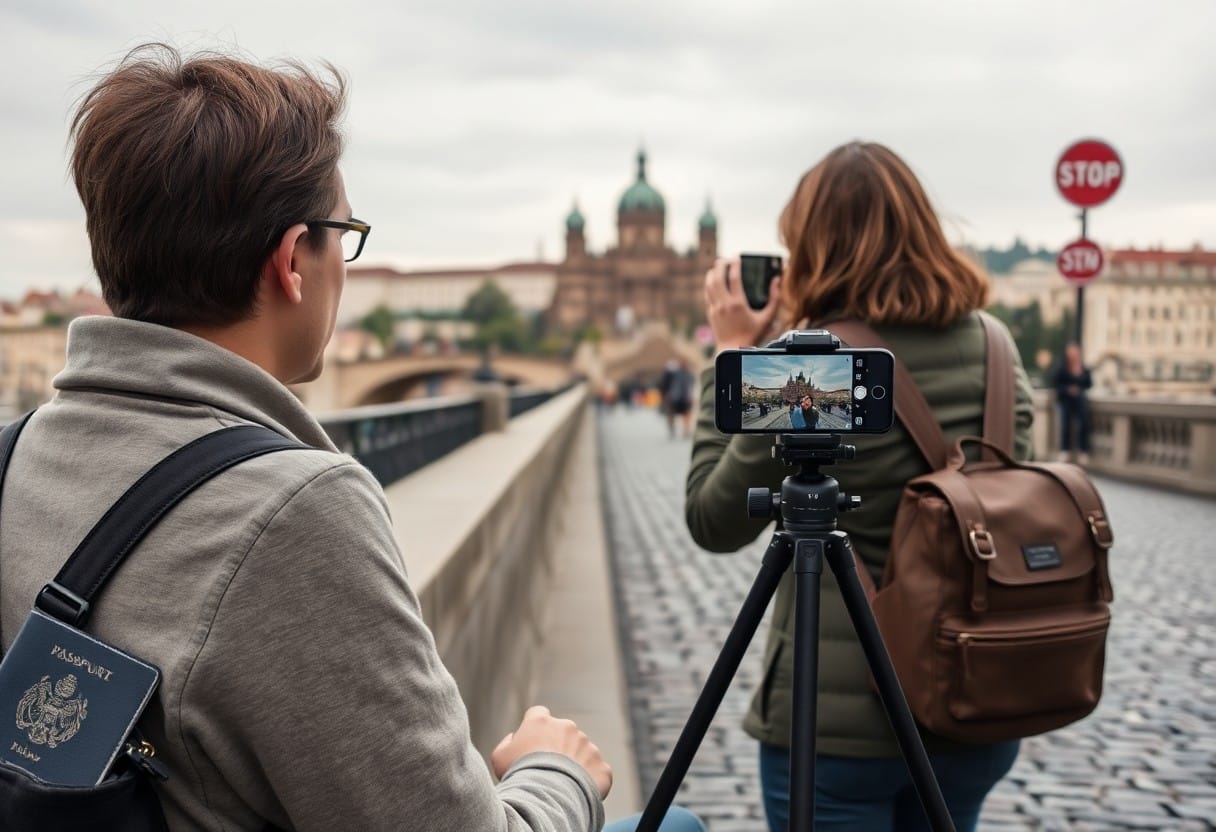
Over your solo travels in Czechia, you must balance creativity with local rules: always ask permission before photographing people, avoid photographing sensitive government sites, and comply with museum and private-property restrictions. Be aware of pickpockets around tourist spots and drone restrictions and no‑fly zones near airports and parks. Protect your gear, carry ID, and embrace the reward: stunning Gothic and Baroque architecture and golden-hour light that make your shots unforgettable.
Types of Photography in Czechia
- Landscape – nature reserves, mountain ranges, and dramatic rivers
- Street – urban life, markets, and tourist hubs
- Architectural – Gothic, Baroque, and UNESCO towns
- Drone – check local bans and no-fly zones
| Landscape | Best at golden hour; bring tripod, ND filters; target Šumava, Bohemian Forest, Český ráj |
| Street | Use 35mm-50mm; be aware of pickpockets in Prague Old Town; public photography generally allowed |
| Architectural | Use tilt-shift or correct distortion in post; interiors (cathedrals, museums) often restrict tripods/flash |
| Permissions | Drones and commercial shoots may require permits from municipalities or site managers |
| Safety & Etiquette | Obey signage, avoid tram tracks, expect fines for ignoring restricted zones |
Landscape Photography
When you pursue landscapes in Czechia, plan for timing and access: arrive 30-45 minutes before sunrise at known viewpoints like the Prachov Rocks or the lakes of Šumava to catch layered light and mist. Use a sturdy tripod, an ND filter for long exposures at waterfalls such as Mumlava, and bracket exposures when scenes include high-contrast skies; shooting a 3-stop bracket (+0, +2, +4 EV) helps you recover details in shadowed castles and bright skies.
Expect varied weather-mountain fog can produce iconic shots but also slippery trails-so pack waterproof boots and a compact first-aid kit. Scout access points in advance because some parks enforce restricted paths during nesting season or forestry work; if you plan sunrise at a remote ridge, leave your location and estimated return time with someone and watch for steep drops near cliff edges.
Street Photography
You’ll find the richest street scenes in Prague, Brno, and Olomouc between 08:00-11:00 and 16:00-20:00, when markets and cafés populate squares; use a 35mm or 50mm prime, shoot around 1/250-1/500s for candid movement, and keep ISO flexible (200-1600) depending on light. Respect personal space and be mindful that while photographing people in public is generally permitted, photographing children or selling identifiable portraits without consent can create legal or ethical issues.
Stay alert in crowded tourist zones-pickpockets target distracted photographers-so keep gear secured and use a crossbody strap; try working from a distance with a 50mm or use environmental portraits in cafés after asking for permission to avoid confrontation. When approaching street performers or religious ceremonies, offer to show a preview or ask politely; often a quick explanation in Czech (“Můžu fotit?”) or English will get you a yes.
More detailed tip: practice a low-profile workflow-single AF point, quiet shutter mode, and pre-set exposure-so you can react in the decisive moment without drawing attention and you can review images later to seek releases for any commercial use.
Architectural Photography
Focus on perspective control and timing: shoot façades in soft side-light during the golden hour to reveal textures on Baroque and Gothic stonework, and use a tilt-shift lens or correct verticals in post to avoid converging lines when photographing spires and façades like those at Prague Castle or Český Krumlov. For interiors, choose f/8-f/11 for depth, bracket exposures for windows and stained glass, and carry a small LED panel if flash is prohibited.
Account for access rules-many churches and museums forbid tripods, professional lighting, or commercial use without permits; if you plan an editorial or paid shoot inside a heritage site, contact the site manager weeks in advance and be prepared to pay fees. Also be mindful of scaffolding or restoration zones that can obstruct classic compositions and create hazardous areas where photography is unsafe or prohibited.
More detailed tip: compile a shot list for each site (wide façade, mid-detail, ornamental detail, interior vault) and schedule visits during off-peak hours-often early weekdays-to minimize tourists and reduce the need for invasive editing or cloning out people.
After checking local rules, scouting light and access, and securing any necessary permits, you can shoot confidently while minimizing risks and maximizing creative results.
Tips for Capturing Great Photos
When you travel alone through Czechia, pack a compact kit that lets you react quickly: a 35mm or 50mm prime plus a 24-70mm zoom covers most scenes, and a lightweight travel tripod under 1.5 kg helps for night shots and long exposures. Keep files in RAW, back up to cloud or a second SD card every evening, and set shutter speeds using the 1/focal-length rule (for a 50mm lens shoot at 1/50 s or faster handheld); if you must push ISO, stay below ISO 800 for clean files when possible. Be mindful of local risks-keep straps over your shoulder, avoid leaving gear unattended, and watch for pickpockets in crowded squares and on trams.
- solo travel: use a small sling bag with quick access to your camera and two cards.
- photography rules: bracket highlights by ±1-2 EV when shooting high-contrast scenes like sunlit facades and shaded alleys.
- golden hour: arrive 20-60 minutes before/after sunrise or sunset for softer light and richer colors.
- Use apps like PhotoPills or Sun Surveyor to plan sun position and blue hour timing for cityscapes.
Timing and Lighting
Try to shoot Prague’s Old Town or Český Krumlov at the edges of golden hour; in June expect sunset near 21:00 and a long, warm light window of roughly 30-60 minutes, while in December sunset can be around 16:00 with a much shorter window. Meter for highlights and use your histogram-if bright sky details clip, expose for the sky and recover shadow detail in RAW or bracket three exposures (-1/0/+1 EV) for later HDR blending.
For river reflections and silky-water effects on the Vltava, use a neutral-density filter and exposures of 5-30 seconds at ISO 100 and f/8-f/11 to keep detail; for portraits at café terraces, open to f/1.8-f/2.8 to separate your subject from cobblestones and background traffic. Use continuous LED or a small reflector for fill when you need to balance faces against strong backlight, and consult local sunrise/sunset tables so you arrive 15-30 minutes early to set up composition.
Composition Techniques
Use the rule of thirds and strong leading lines-bridges, tram tracks, and river edges work well-to pull the viewer into the frame; position a person at one third to provide scale against baroque facades or the 30 statues lining Charles Bridge. Frame with archways or doorways for natural vignettes, and choose apertures based on intent: f/8-f/11 for sharp cityscapes, f/1.8-f/2.8 for environmental portraits that isolate your subject from busy backgrounds.
For symmetrical subjects like the Astronomical Clock or cathedral portals, center composition can be more striking than rule-of-thirds; shoot multiple focal lengths-24mm for context, 50-85mm for detail-and use low angles to emphasize cobblestone texture and foreground leading lines. Incorporate negative space on the sky side to give breathing room in festival or market scenes where crowds are dense.
Practice bracketing 3-5 exposures for difficult light, use focus stacking (5-7 frames) for extreme depth scenes, and stitch panoramas with 30-50% overlap when you need a wider field than your lens allows. Recognizing which mix of timing, lighting, and composition techniques suits each scene will make your solo travel photography in Czechia consistently stronger.
Step-by-Step Guide to Planning Photography Sessions
| Researching Locations | Researching LocationsYou should use PhotoPills or The Photographer’s Ephemeris alongside Mapy.cz and Google Street View to map composition points and sight-lines; for instance, plan Charles Bridge shots from the eastern end at least 30-45 minutes before sunrise to avoid crowds and get the low-angle light. Check seasonal daylight: expect roughly ~16 hours in midsummer and as little as 8-9 hours in midwinter, which affects how many locations you can realistically cover in a day. Also verify local access and legal constraints: many castles and protected sites require written permission for tripods or drone use, and national parks may ban off-trail photography. Use recent Flickr/Instagram geotags and local Facebook groups for up-to-date conditions (ice on cobbles, closures), and note travel times-Český Krumlov is about 2.5-3 hours from Prague by public transport, so plan it as a full-day shoot. |
| Preparing Gear | Preparing GearPack with redundancy: carry at least two spare batteries, two memory cards (one in camera, one in bag), and a minimum of 64 GB card for RAWs if you shoot high-resolution files. Choose lens selection based on itinerary-bring a 16-35mm for landscapes and tight architecture, a 24-70mm for general travel, and a 70-200mm if you expect distant details; for long exposures include a sturdy but lightweight carbon tripod under ~1.5 kg for solo mobility. Include practical accessories: a circular polarizer, a 6-10 stop ND for river/long-exposure work, a remote release or intervalometer for star stacks, and weather protection (rain cover, silica gel). Keep gear in an anti-theft camera backpack and have a small repair kit (lens pen, microfiber cloth, multi-tool) in the top pocket. For backups and power, use a portable SSD or a 1-2 TB travel drive and enable nightly Auto-Upload to Lightroom Mobile when you have a stable connection; bring a USB-C power bank and a Type E adapter for Czech outlets (230V). Keep your gear dry and concealed and test all batteries and cards the night before a multi-location day to avoid downtime. |
| Scheduling Your Shots | Scheduling Your ShotsBlock your day around light windows: allocate 60-90 minutes for golden hour compositions, reserve 30-45 minutes for scouting and mid-morning cleanup, and set aside a 45-90 minute slot for blue hour/night exposures. For a Prague skyline at sunset, arrive at least 45 minutes early to test angles and exposure bracketing; for rural sunrise (fog-prone valleys in autumn), plan to arrive 60-90 minutes pre-dawn to catch the lift of mist. Factor transport buffers: add 30-60 minutes to train or bus connections and schedule a full travel day between distant sites like Prague and Moravian wine country. Use weather services such as Windy and Meteoblue to confirm wind, fog probability, and cloud cover the evening before, then set calendar alarms and route backups so you can shift from an outdoor plan to a covered location if conditions change. Create a prioritized shot list with plan A/B compositions and time estimates for each stop (e.g., 20 min for detail, 45 min for panoramic). That lets you swap to nearby interiors or cafés while waiting for light and reduces solo-travel risk when shooting remote viewpoints after dark. |
Factors to Consider While Shooting
Balance practical and creative choices by weighing light, safety, permissions and timing for each shoot: Prague’s Old Town fills between 10:00-18:00 in high season, Charles Bridge peaks midday and is far quieter at sunrise, and small villages in South Bohemia can be photo-friendly but sensitive to intrusion. Pack for mobility-a 35mm or 50mm prime plus a travel zoom keeps you agile-and plan backup power because battery life can fall sharply in cold weather.
- Weather: daylight ranges from ~16-17 hours in June to ~8 hours in December in Prague.
- Crowds: Charles Bridge and Old Town Square busiest 10:00-17:00 in summer.
- Permissions: museums and churches often ban tripods or flash and may charge fees.
- Safety: watch for icy cobbles in winter and increased pickpocketing around tourist hubs.
- Local etiquette: always ask before shooting people-showing a photo builds goodwill.
Weather Conditions
Expect continental shifts: summers average 20-25°C in July with occasional thunderstorms, winters often drop below 0°C with snow common in higher ground (Krkonoše and Šumava). Protect gear with a simple, effective kit: a rain cover for sudden showers, a microfibre cloth for condensation, and silica packs for long multi-day trips. In sub-zero temperatures plan for a 30-50% drop in battery performance-carry two cold spare batteries inside your jacket to keep them warm.
Use daylight data to your advantage: sunrise in Prague can be as early as ~4:15 in June and as late as ~8:00 in December, while sunsets swing from ~21:00 to ~16:00; schedule cityscapes and long exposures for blue hour and early morning to avoid crowds. Overcast days give soft, even light ideal for portraits in historic town centers like Český Krumlov, and for flowing-water shots on the Vltava use ND filters and a stable support-while noting that enforcement around landmarks may prohibit tripods during busy periods so carry a lightweight monopod as a compromise.
Local Customs and Etiquette
You should approach people with simple, polite phrases-“Mohu fotit?” (Can I photograph?) or “Mohu vás vyfotit?” (May I photograph you?)-and be prepared to accept refusals without debate; many Czechs value privacy and will decline. Inside religious sites like St. Vitus Cathedral and smaller parish churches, flash and tripods are often restricted and some places ask for a small donation or permit for photography, so always check signs or ask staff before setting up.
When photographing street performers or staged scenes be ready to offer a small payment if they request it-during summer festivals in Český Krumlov performers commonly expect compensation for posed images. Avoid photographing police operations or private protests; while public photography is generally allowed, it can escalate interactions in tense situations and draw unwanted attention to you as a solo traveler, making it safer to step back and shoot from a distance.
Use practical tools: keep a translation app with phrases saved, carry business cards or a printed note that explains you are a solo travel photographer, and always show the subject the image on your screen-this often converts a refusal into a yes; for commercial use obtain written consent because model-release requirements apply more strictly when images are sold or published.
Assume that you carry a small translator app and a printed permit or contact info when you plan shoots that might require permissions.
Pros and Cons of Solo Photography Travel
| Pros | Cons |
|---|---|
| Complete creative control – you choose locations, timing and compositions without compromise. | Safety risk when alone – increased vulnerability in isolated spots or at night. |
| Ability to wake for sunrise or blue hour on demand (arrive 45-90 minutes before sunrise for Charles Bridge). | Carrying all gear solo creates physical strain and slows movement on long treks. |
| Faster decision-making – you can extend a shoot by hours in towns like Český Krumlov or shorten it if weather turns. | Limited ability to manage complex setups (assistants, reflectors, model direction). |
| Lower cost per person and more flexibility to choose budget or premium options for accommodation and transport. | Higher exposure to theft in crowded tourist areas – pickpocketing is common in hotspots. |
| Deeper immersion and quieter observation that yields candid street photos and authentic local interactions. | Language and permit hurdles: securing church or drone permissions can be slower without a local helper. |
| Opportunity to focus on personal projects and build a distinct portfolio quickly. | Emergency logistics (medical, transport breakdowns) are harder to resolve alone, especially outside Prague. |
| Ease of adapting itineraries – jump from Prague to Český ráj or Bohemian Switzerland based on light and weather. | Weather can be unpredictable in the mountains; sudden fog or rain can ruin plans without backup days. |
| You learn practical field skills faster: packing light, quick lens swaps, and fast scouting techniques. | Restrictions on tripods, flash or indoor photography in historic sites may limit technical options. |
| Chance to meet locals and fellow travelers on your terms, often leading to unique portrait opportunities. | Photographing commercial subjects or private property can require permissions and possible fees (some churches charge ~50-150 CZK). |
| Greater personal growth and confidence from solving on-the-spot problems. | Insurance and gear protection can be more complicated when you travel light and solo. |
Advantages of Solo Exploration
You can control the shot list entirely: for instance, arrive at Charles Bridge before 5:00-6:00 in summer to capture empty spans and reflected towers, then shift to Mala Strana for low-angle cobblestone textures. Spending 1-3 hours on composition in one location is normal when you travel alone, and that focus often yields frames you won’t get rushing with a group.
Because you move at your own pace you can exploit micro-opportunities – catching a fisherman on the Vltava at golden hour, or staying an extra hour in Bohemian Switzerland when the light breaks through mist. Creative flexibility also means you can test gear setups (long exposures, timelapses) without scheduling conflicts or team compromises.
Potential Challenges
Safety is the most immediate concern: busy tourist hubs like Old Town Prague and the areas around main stations attract pickpockets, so keep valuables secured in anti-theft bags and use money belts in crowded trams. Nighttime shooting in less lit districts demands extra caution; plan routes, share your location with someone, and avoid isolated alleys after midnight.
Logistics and permissions can slow you down. Drones require checking local rules – flying near Václav Havel Airport or over national parks like Bohemian Switzerland often needs permits or is prohibited, and many churches restrict tripods or flash and may ask for a small fee (~50-150 CZK) to photograph interiors. You must budget time to inquire in Czech or find an on-site attendant who speaks basic English.
Gear management becomes a practical challenge: you have to carry spares (batteries, cards), secure backups, and decide what to leave in accommodation. Consider a compact backup kit (one prime, one zoom, two batteries, 2-4 cards) so you can be nimble; this reduces fatigue and lowers the chance that a single theft or failure wrecks an entire day’s work.
Essential Gear for Solo Photographers
When you travel solo in Czechia, pack a balanced kit that covers architecture, street scenes and low-light shots without weighing you down: aim for a total day kit under 5 kg so you can walk cobblestone streets and climb towers all day. Bring one versatile zoom (24-70mm f/2.8 or 24-105mm f/4), a fast prime like a 35mm or 50mm for low-light and portraits, plus a compact travel tripod and at least two spare batteries and two 64-128GB SD cards. If you want location-specific tips for Prague, consult My Photography and Travel Guide To Prague, Czech ….
You should also plan for safety and weather: carry a rain cover and silica packets for humidity, keep expensive gear out of sight on trams and at crowded spots, and lock valuable items in your accommodation safe. Expect busy summer weekends at sites like Charles Bridge and Prague Castle; pickpocketing risk increases in crowds, so use a secure sling bag or anti-theft backpack and consider short-term equipment insurance for high-value bodies or lenses.
Recommended Camera Equipment
For bodies, choose a mirrorless full-frame like the Sony A7 IV, Canon R6, or Nikon Z6 II for better high-ISO performance and compactness; if you prefer lighter weight, Fujifilm X-T4 (APS-C) performs strongly too. Aim to shoot with one primary body and one backup option (either a second body or a reliable compact camera) if you can – backups significantly reduce risk when you’re traveling solo. A stabilized lens or in-body image stabilization (IBIS) helps massively for handheld night shots of Prague’s lit façades.
Lenses drive the look: bring a wide zoom (16-35mm or 15-35mm) for gothic and baroque architecture, a standard zoom (24-70mm) for everyday versatility, and a 35mm or 50mm prime for street work and low-light scenes at apertures like f/1.4-f/1.8. If you plan portraits or want compression from a distance, add a 70-200mm (f/4 for weight savings, f/2.8 if you need fast apertures). Carry filters sized to your main lens (polarizer and 3-6 stop ND) and know the thread diameter – 67mm and 77mm are common numbers to check.
Accessories for Success
Bring a compact travel tripod (carbon-fiber if you can afford it) that folds small but supports at least 3-4 kg of gear; brands like Peak Design and Gitzo offer reliable, lightweight options. Also pack a remote shutter or smartphone intervalometer for long exposures, a microfiber cloth and sensor blower for cobblestone dust, and a quality camera strap that lets you switch between chest carry and sling modes quickly. Flash and small LED panels are optional but useful for portraits in cafés or dim interiors.
Power and storage matter: carry a 20,000 mAh power bank with USB-C PD to charge phones and mirrorless batteries (or a multi-battery charger), and rotate memory cards daily to minimize data loss – shoot to two cards if your camera supports overflow/backup. For organization, use labeled waterproof pouches so you can swap filters, batteries and cards quickly while keeping gear protected from sudden rain or snow.
For additional safety and convenience, use an anti-theft backpack with lockable zippers and a padded insert, and keep a small set of travel tools (allen keys for tripod heads, a multitool) in an external pocket. If you plan nighttime or winter sessions, bring a headlamp with a red-light mode so you can change settings without ruining night exposures, and register your gear with a serial-number tracker or insurance policy to make recovery or claims faster if something goes missing.
To wrap up
Drawing together your solo photography in Czechia, you should balance creative ambition with legal and cultural awareness: respect property signs and restricted zones, comply with drone and national park regulations, and seek permission for indoor, commercial or close-up portraits. You must protect your gear and personal safety in crowded tourist spots, carry backup batteries and memory cards, and use visible straps or locks so your equipment is secure while you frame cityscapes, castle exteriors, and landscapes.
When you plan shoots, prioritize golden hour, scout locations using maps and local advice, and learn a few Czech phrases to ask for consent when photographing people or interiors; this will improve access and results. Keep copies of important documents, insure valuable equipment if possible, and approach each scene with respect for local customs so your images are legally compliant and culturally sensitive while still reflecting your solo travel perspective.
FAQ
Q: Can I take photographs anywhere in public in Czechia?
A: Yes, casual photography in public spaces is generally permitted, but there are important limits. Do not photograph people in a way that violates their personal rights if you intend to publish or use the images commercially – obtain written consent for commercial use or identifiable portraits, and avoid distributing images of private individuals that could harm their reputation. Sensitive sites such as police operations, military installations, courtrooms, prisons and certain border or airport areas may be restricted; follow posted signs and instructions from officials. If someone asks you to stop or delete images of them on private property, comply to avoid escalation.
Q: What rules apply when using a drone while traveling solo in Czechia?
A: Drone operations must follow EU/UAS regulations and Czech national rules: register your drone/operator if required, follow geofenced no-fly zones (airports, military areas, some protected zones and city-center restrictions), maintain visual line of sight, keep required minimum distance from people and crowds, and observe altitude limits. For commercial work or flights near sensitive infrastructure you will usually need prior authorization from the Civil Aviation Authority or local authorities. Use official apps or NOTAMs to check temporary restrictions, carry proof of registration/permissions, and obtain liability insurance if operating beyond hobby limits.
Q: Are there special rules for photographing historic sites, museums, and crowded tourist spots like Prague’s Old Town?
A: Many heritage sites, museums and churches restrict flash, tripods, or professional equipment and may require a paid permit for commercial or staged shoots; some areas prohibit photography entirely. At crowded attractions (Charles Bridge, Old Town Square) be mindful of local regulations and pedestrian flow: avoid blocking access, set up equipment only where allowed, and expect stricter enforcement during events. Street performers, vendors or private property owners may request payment or refuse photography – ask first and obtain written permission for commercial use. Always check the site’s official website or contact local authorities before planning a formal shoot.

Hello, I am Jan, a travel writer based in the Czech Republic. I specialize in discovering and writing about my homeland—medieval towns, mountain hikes, the local pub scene, and off-the-tourist-radar destinations.
I also write about life as an expat in Czechia—just what it is like to live here, and not just visit. That means the little victories, the cultural surprises, and the daily realities of establishing life in this side of the world. If you’re considering visiting or making the move, I hope to give you an authentic, realistic sense of what life in Czechia is all about.