
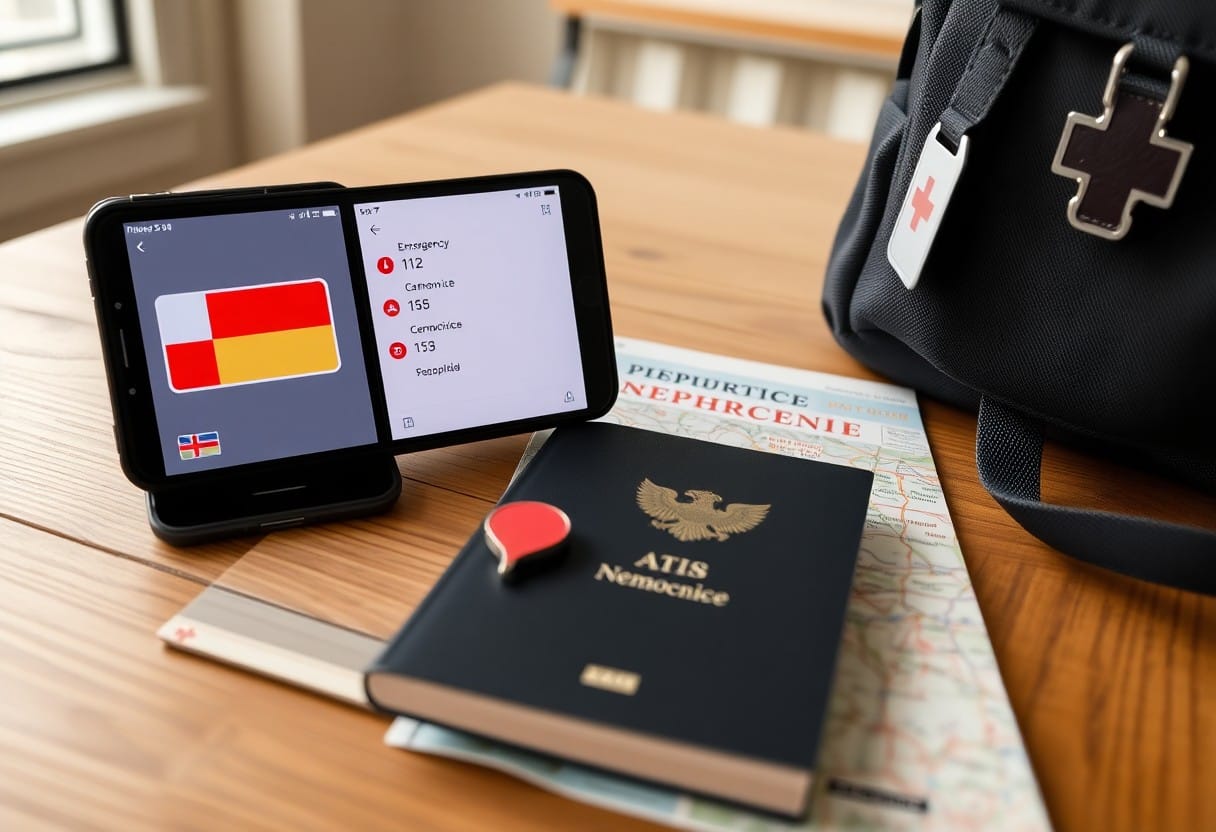
There’s a clear path for emergencies: dial 112 (or 155 for ambulance, 158 for police, 150 for fire); you should carry your ID, local address and your travel insurance and EHIC/GHIC. If you face severe bleeding, chest pain or breathing problems seek immediate care; for non-urgent issues use clinics or pharmacies (lékárna) and ask for English-speaking services, and keep embassy and local contacts saved on your phone.
Types of Emergency Contacts
Sort your list into clear categories so that when seconds matter you can find the right number: local emergency contacts, nearby healthcare facilities, pharmacies on duty, and your embassy or insurer. Use a simple priority order in your phone and on a printed card: primary emergency numbers, then local hospital ERs, then consular and insurance hotlines.
- Local emergency services (police, ambulance, fire)
- Hospitals and urgent care
- Pharmacies on duty
- Embassy / consulate
- Insurance 24/7 hotline
| Ambulance | 155 (or 112) – medical emergencies, severe trauma, chest pain |
| Police | 158 (or 112) – reporting assaults, theft, or traffic incidents |
| Fire brigade | 150 (or 112) – fires, rescues, hazardous spills |
| EU-wide emergency | 112 – routes calls to the correct service and can often provide help in English |
| Embassy / Insurer | Your embassy emergency line and insurer’s 24/7 hotline – for lost passports, legal aid, or evacuation |
Local Emergency Services
You will normally call 112 if you are unsure which service you need; the dispatcher will connect you to 155 (ambulance), 158 (police) or 150 (fire). When you speak, state your exact location (street name and nearest building number or landmark), the number of injured people, and the nature of the incident – this speeds up response and ensures the correct units are sent.
In Prague and other urban areas ambulance response times are often under 15 minutes for life‑threatening calls, while rural response can be longer – you should be prepared to give clear directions and follow first‑aid guidance from the dispatcher until help arrives.
Healthcare Facilities
For severe injuries or chest pain go straight to an ER at a university or regional hospital; Prague’s major centres serve as trauma hubs and have 24/7 emergency departments. If your issue is urgent but not life‑threatening, many private clinics and urgent care centres accept walk‑ins and have English‑speaking staff – check online reviews and call ahead when possible to confirm services and fees.
If you are an EU citizen carry your EHIC (or UK GHIC where applicable) to access state healthcare; otherwise call your insurer’s 24/7 number before treatment to arrange approvals and repatriation options. Pharmacies (lékárna) operate on a rotating night duty schedule – search for “noční lékárna” for the local roster or check signage on nearby pharmacies.
Many hospitals publish maps and ER triage information online; you should save the nearest hospital address and the names of two English‑speaking clinics in your destination so you can get to care quickly if you lose mobile service.
Embassy and Consulate Contacts
Contact your embassy or nearest consulate for help with lost or stolen passports, arrest, or locating local lawyers and doctors; embassies typically provide a 24/7 emergency line distinct from office hours and can issue emergency travel documents. Save the embassy’s address, non‑emergency number, and its emergency hotline in your phone and note whether it requires appointments for consular services.
Before travel register with your country’s traveler‑registration service (for example the U.S. STEP program or similar), so the embassy can reach you during natural disasters or civil disturbances and provide alerts specific to your area.
Thou save the embassy emergency hotline, the physical address, and your insurer’s repatriation number in multiple places (phone, cloud, paper) so you can access them even if your primary device fails.
Tips for Solo Travelers
Plan practical safeguards before you head out: save the main emergency lines with the country code +420 and store your embassy contact, policy number for travel insurance, and an ICE (in case of emergency) contact under multiple labels in your phone. Keep a photocopy of your passport and insurance card in your luggage and a digital copy in a secure app so you can access them if your phone is lost. In busy tourist spots like Prague’s Old Town and Charles Bridge there is a higher incidence of pickpocketing, so use a hidden money belt and carry only the cards you need.
- Save 112, 155, and 158 under several contact names and include the local police station and your embassy website link.
- Carry a local SIM or a reliable eSIM for data – navigation and emergency apps rely on connectivity.
- Know the nearest large hospital – for Prague that’s FN Motol (Motol University Hospital) – and its general location relative to where you stay.
Keep copies of booking confirmations and medication lists; if you have allergies, add them to both your phone medical ID and a paper card in Czech or with a clear icon so a bystander can understand. Store one contact as “ICE-Emergency” and another as your embassy to speed up assistance if language barriers appear.
Preparing Emergency Numbers
Save national numbers using the international format: put +420 112 (EU emergency) plus direct lines +420 155 (ambulance) and +420 158 (police) in your primary contacts, then pin them in your phone so they are reachable from the lock screen. Add your insurer’s 24/7 hotline, the nearest hospital’s main switchboard, and your embassy’s general assistance line – store at least one contact that speaks your language or offers 24-hour consular help.
Keep a small laminated card with the same numbers and your blood type/allergies in Czech on it; presenting it to a dispatcher or paramedic can save time when seconds matter. If you use a local SIM, program those numbers again with the local prefix so calls connect immediately, and test each number on arrival to confirm routing.
Utilizing Mobile Apps
Install the Czech emergency app Záchranka – it transmits exact GPS coordinates to emergency dispatchers and allows you to store medical data and contacts for first responders. Complement it with reliable mapping apps like Mapy.cz (excellent offline maps for hiking and public transport) and Google Maps offline packs for urban navigation; pre-download maps for areas you plan to visit.
Set up each app before you travel: enter your medical profile in Záchranka, link a trusted contact for location sharing, and enable SOS features that call 112 when triggered. Also install a translation app or phrasebook that works offline for quick symptom descriptions to medics and police.
After installing and configuring these apps, run one on-the-spot test (for instance, share a live location with your ICE contact and open an offline map) so you know how they behave when you actually need them.
Step-by-Step Guide to Accessing Healthcare
Quick action summary
| Situation | Immediate action |
| Life‑threatening emergency | Call 112 or 155 for ambulance; go to the nearest emergency department (oddělení urgentní péče). |
| Serious but not immediately life‑threatening | Attend a hospital ER or urgent care; expect triage and waits that can range from 30 minutes to several hours in large centers. |
| Non‑urgent / routine care | Book a GP or private clinic visit (poliklinika or soukromá ordinace); many private clinics accept online booking and payment up front. |
| EU / UK insured visitors | Present your EHIC/GHIC at state facilities for treatment on the same terms as locals; it does not cover private care or repatriation. |
| Non‑EU visitors or private care | Use travel insurance; you will typically pay up front (card/cash) and submit receipts for reimbursement. |
Finding a Healthcare Facility
When you need care, search for “nemocnice” (hospital) or “urgentní příjem” (emergency admission) plus your city in Google Maps or a local directory – in Prague, examples are Všeobecná fakultní nemocnice and Motol for children and trauma. Use expat Facebook groups or the Ministry of Health map to locate 24/7 emergency departments; ambulance response (155/112) is the fastest option for unstable patients.
For non‑emergencies, identify private clinics (soukromé ordinace) that list English‑speaking staff and online booking; pharmacies (lékárna) can handle minor problems and advise on OTC meds. Keep a saved list on your phone with one hospital, one private clinic and the nearest lékarna so you can act immediately.
Understanding Payment Methods
If you hold an EHIC/GHIC, present it at state hospitals to receive treatment on the same terms as Czech insured patients – it usually removes the need for immediate payment for necessary care, but does not cover private treatment or repatriation. For private clinics and many walk‑in services you should expect to pay up front by card or cash; clinics will provide an itemized invoice for insurance claims.
Travel insurance is the primary protection for non‑EU visitors: confirm your insurer’s emergency assistance number before travel, carry a digital and paper copy of the policy, and verify whether the insurer guarantees payment to providers or requires you to pay and claim later. In practice, larger private hospitals often accept major credit cards and issue invoices in English to simplify reimbursement.
After any visit, keep all receipts, invoices with CPT/ICD codes if provided, and a short written note of the diagnosis or procedures; insurers typically require itemized bills and copies of prescriptions to process claims, so a scanned packet will speed up reimbursement.
Communicating with Healthcare Professionals
State clearly what happened, current medications and allergies; begin with the vitals – “mám alergii na…” for allergies and list drug names – and hand the clinician any medication packaging. Many Prague and Brno hospitals have English‑speaking staff, but in smaller towns you should be prepared to use a translation app or carry a one‑page symptom/medical‑history note in Czech to avoid misunderstandings.
Ask for a written summary of the diagnosis, prescribed medicines (including dose and duration), and any follow‑up instructions; if you need an international prescription or a copy of imaging/lab results, request them before leaving. Emphasize urgent issues such as breathing difficulty, uncontrolled bleeding, high fever, or severe allergic reaction with clear, repeated statements so triage assigns the correct priority.
If language becomes a barrier, request a hospital interpreter or use your insurer’s emergency assistance line to arrange one – consulates can also help liaise in serious cases, and having a printed power‑of‑attorney or emergency contact authorization speeds communication when someone else must make decisions for you.
Factors to Consider in an Emergency
When you face an urgent situation while traveling alone, prioritize having a clear set of emergency contacts, a local healthcare destination, and your insurance details ready. Carry digital and paper copies of your passport, policy number and two local contacts; if you need an ambulance call 155 or the EU-wide 112. Keep one easy-access note with the nearest hospital and your country’s embassy phone, and be aware that bills for uninsured visitors can exceed several thousand euros for inpatient care.
- emergency contacts: local police (158), ambulance (155), tourist police in big cities
- healthcare facility: nearest hospital name and address (e.g., FN Motol, VFN Prague)
- insurance: policy number, 24/7 helpline, coverage limits and excess
- local language support: translation apps, embassy assistance, on-call interpreters
- transport: nearest tram/metro stop, taxi phone, roadside accessibility for emergency vehicles
If you need practical guidance on where to go in Prague or how outpatient emergency services (pohotovost) operate, consult local resources such as Health Care System | Prague for all for clinic hours and contact details; this can save time when every minute matters.
Location and Accessibility
In cities like Prague you can expect ambulance response times around 8-12 minutes in central districts, while in rural areas response may extend to 20-40 minutes, so factor distance into your decision whether to call for transport or get to a clinic yourself. You should note the closest major hospitals – for example, FN Motol and General University Hospital (VFN) – which offer 24/7 emergency departments and are reachable by public transit from most central areas.
Assess physical access before you travel: confirm whether the clinic has ground-floor entry, elevator access and wheelchair facilities if you have mobility limitations, and check if taxis or ambulance crews can reach your exact address (some medieval streets in towns restrict vehicle access). Keep a screenshot of directions and the clinic phone number so you can show them to drivers or emergency responders.
Insurance Coverage
Verify your policy limits before departure: if you are an EU resident, an EHIC/GHIC covers state-provided care but may not cover private treatment, ambulance repatriation or return flights; private travel insurance should include medical evacuation and at least €50,000 in medical cover for serious incidents. You must keep your insurer’s 24/7 emergency line and your policy number on hand for pre-authorization of expensive procedures when required.
Ask your insurer whether they handle direct billing with Czech hospitals-without direct billing you will need to pay upfront and claim later, so carry a credit card with sufficient limit and keep all receipts. Save contact details for the insurer’s medical assistance partner and confirm whether prescription medications are covered or require prior approval.
If evacuation or repatriation becomes necessary, contact your insurer immediately since arranging a medical flight can take 24-72 hours and cost €5,000-€30,000 depending on distance and level of care; keep copies of prescriptions and diagnostic reports to speed up approval and claims.
The final step is to store all local emergency numbers, your insurer’s emergency line and a map to the nearest emergency department in both your phone and on paper.
Pros and Cons of Solo Travel in the Czech Republic
Pros vs Cons of Solo Travel
| Pros | Cons |
|---|---|
| Efficient public transport in major cities (metro, trams, buses) | Limited services and less frequent connections in rural areas |
| Easy day trips – Prague to Český Krumlov ~2.5 hours by train/bus | Some regional trains/buses run only a few times per day, affecting plans |
| High density of hostels, guesthouses and solo-traveler networks | Periods of loneliness when you want shared experiences |
| Relatively affordable compared with Western Europe for food and lodging | Tourist-season price spikes in Prague and major attractions |
| Good emergency services in urban areas (ambulance, police via 112) | Petty theft and pickpocketing in crowded tourist spots |
| Plenty of cultural sites and English signage in cities | Lower English proficiency in villages; language can be a barrier |
| Access to private clinics and international doctors in Prague | Private care can be expensive without insurance |
| Well-documented safety advice via official sources | Delayed care possible in remote mountain areas or late-night incidents |
Advantages of Solo Travel
You can move at your own pace and pick an itinerary that fits you: hop on a metro in Prague every 2-5 minutes during peak hours, take a direct regional train to Český Krumlov in about 2.5 hours, or spend a quiet morning in a café in Brno without coordinating with others. Solo travel also makes it easier to change plans on the fly – you can extend a stay in a town you love or switch to a private clinic if you prefer faster, English‑speaking care.
Because many hostels and walking tours cater to single travelers, you often meet people when you want to and travel alone when you don’t. For practical backup, if you need a vetted list of English‑speaking doctors or local medical resources, consult the embassy directory: Medical Assistance – U.S. Embassy in The Czech Republic, which points you to clinics and specialists in Prague and other cities.
Challenges and Risks
When you travel alone, be aware that crowded tourist areas such as Old Town Square and Charles Bridge have a higher incidence of pickpocketing and bag snatches; petty theft is the most common crime affecting visitors. Language gaps outside major cities increase the chance of miscommunication during a medical visit or when reporting an incident to local police, so keep necessary phrases, emergency numbers, and a local contact handy.
Healthcare access is solid in urban centers, but if you’re in a small town or hiking in the Šumava or Krkonoše ranges, you may face delayed response times and limited on‑site treatment options. Carry comprehensive travel insurance, have clear documentation of your policy and emergency contacts, and know whether your home-country healthcare agreements (like the EU EHIC for EU citizens) apply to you.
Additionally, plan for seasonal hazards: winter conditions can produce icy trails and rapidly changing weather in mountainous areas, and late-night bar districts increase exposure to alcohol-related incidents – both raise the chance that you’ll need assistance when help is farther away than in central Prague. Stay informed of local alerts, share your itinerary with someone you trust, and keep digital and physical copies of your insurance and emergency contacts.
Final Words
The best way to handle emergencies while traveling solo in the Czech Republic is to prepare before you leave and keep key resources at hand: save emergency numbers (112 for EU-wide emergencies, 155 ambulance, 158 police, 150 fire), store the address and phone of your nearest embassy or consulate, carry your European Health Insurance Card (EHIC) or proof of travel insurance, and note nearby hospitals or 24/7 clinics where you’ll be staying. Keep a digital and paper copy of prescriptions, allergy information, and contact details for a trusted friend or family member so you can get help quickly if you need it.
The healthcare system is accessible if you know how to navigate it: for life-threatening issues go straight to a hospital emergency department, for non-urgent concerns visit a walk-in clinic or a lékárna (pharmacy) for advice, and call your insurer’s hotline to locate English-speaking providers and confirm payment arrangements. Keep your phone charged, share your itinerary with someone at home, and notify your embassy for assistance with medical documentation or liaison services if you face legal or health-related complications.
FAQ
Q: What emergency numbers and services should a solo traveler in the Czech Republic know?
A: Dial 112 for any life‑threatening emergency – it reaches ambulance, police and fire services anywhere in the EU and can connect you to English‑speaking dispatchers. Direct local numbers: 155 (ambulance), 158 (police), 150 (fire brigade), 156 (municipal police). For poison incidents contact the Czech Toxicological Information Centre at +420 224 919 293.
When you call give your exact location (address, landmark or GPS coordinates), the nature of the incident, the number of people affected, any allergies or medications, and your phone number; stay on the line until the dispatcher says it’s OK to hang up. Store ICE (In Case of Emergency) contacts on your phone, use a visible emergency card in your wallet, and save your insurer and embassy numbers in an easy‑access place.
Q: How do I access medical care (GP, emergency department, pharmacies) as a solo traveler and what should I bring?
A: For life‑threatening conditions go to the nearest hospital emergency department (oddělení urgentní péče) or call 112/155. For non‑urgent problems use an after‑hours duty doctor service (lékařská pohotovost), walk‑in urgent care clinics, or private clinics and polyclinics; many larger cities have English‑speaking private practices. Pharmacies (lékárna) are widely available and a rotating roster of “on‑duty” night pharmacies (noční lékárna) covers nights and weekends – schedules are posted at pharmacies and online. Bring passport/ID, your European Health Insurance Card (EHIC/GHIC) if applicable, travel insurance details and policy number, credit/debit card, a list of current medications and dosages, any prescriptions, and allergy information. Ask for itemized receipts and medical reports to file insurance claims.
Q: What preparations and in‑trip actions help solo travelers handle medical emergencies effectively?
A: Before departure, register emergency contacts with family and your embassy/consulate, scan and save copies of passport and insurance documents, list chronic conditions and medications, and download offline maps and a translation app with medical phrases (e.g., “potřebuji lékaře” = I need a doctor). Share your itinerary or enable location sharing with a trusted contact. During an emergency, call 112 first for severe situations, follow dispatcher instructions, keep identification and insurance details with you, and notify your insurer as soon as feasible so they can assist with referrals, guarantee of payment, or evacuation if needed. If treated, obtain full documentation (diagnosis, prescriptions, receipts) for reimbursement and contact your embassy if you need legal, language or family‑contact assistance.

I’m Jan, a Czech writer, hiker and travel guide born in Bohemia and based in Prague. I’ve been writing about my home country for 9 years, and I know it the way you only do when you’ve grown up here: the trail signs that locals actually follow, the pubs that aren’t in any guidebook, the castles that get overlooked because they’re not on a tour bus route.
Over 9 years I’ve covered every corner of the Czech Republic, from the Krkonoše ridges and Šumava forests to the wine cellars of South Moravia and the spa towns of West Bohemia. I’ve taken 40+ solo trips across Czechia, Slovakia, Poland, Hungary and Austria and I write in Czech and English, which means I can read the local hiking forums, regional news and municipal information that never gets translated.
My writing covers three areas: practical solo travel in Czechia (getting around by train and bus, hiking safely, visiting castles and landmarks without the crowds), expat and long-term living (the cultural surprises, the bureaucracy, what it actually costs, how the healthcare and transport systems work), and off-the-radar Czech Republic, the places most visitors never reach because they spend all their time in Prague.
Prague is extraordinary, but it’s maybe 10% of what this country has to offer. The rest is what I’m here to write about.