
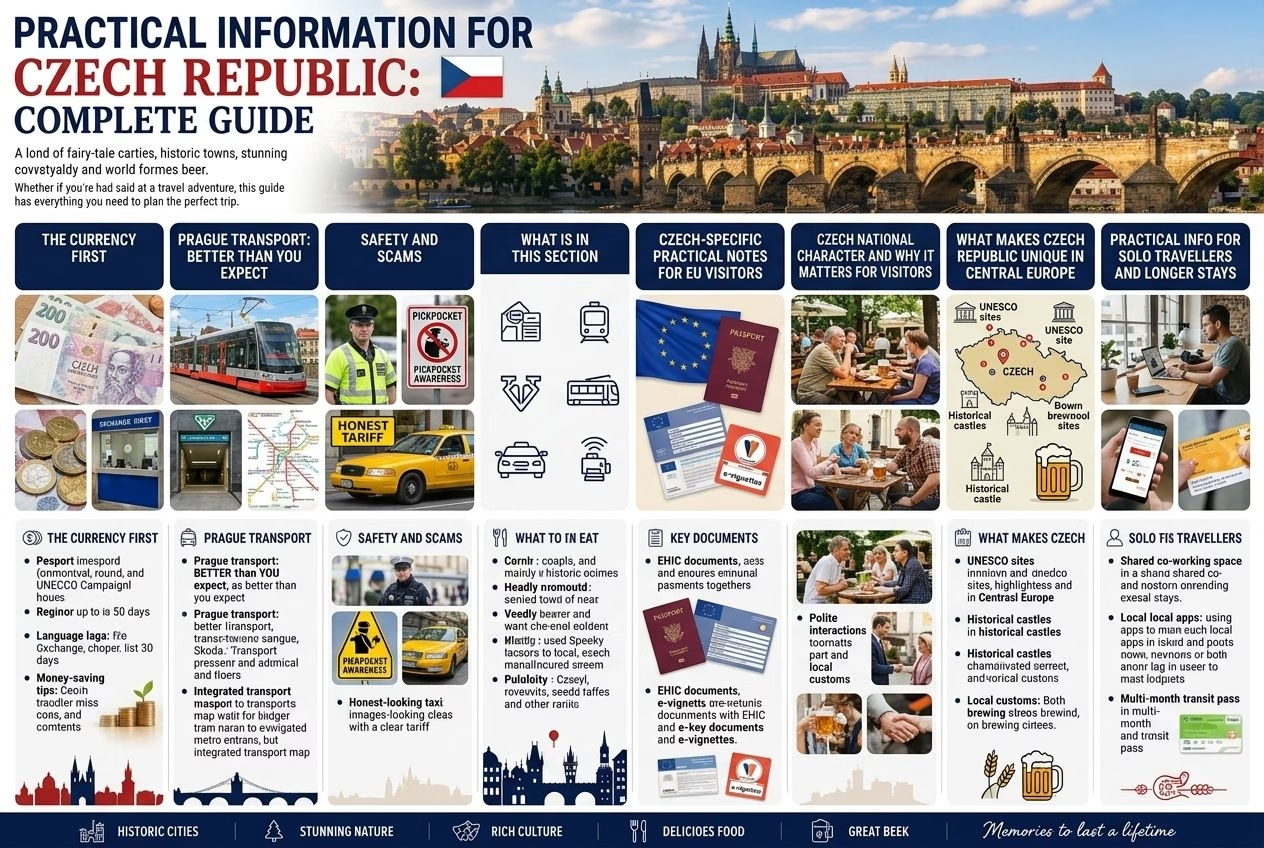
The Czech Republic has specific practical characteristics that require knowing before arrival. The currency is not the euro; the taxi situation in tourist areas is genuinely predatory; the tram and metro system is excellent but has a ticketing logic that trips up first-time visitors; and the Czech scam landscape is more developed than most Western European cities. This section covers all of it.
The Currency First
The Czech Republic is an EU member but uses the Czech koruna (CZK) rather than the euro. This surprises many visitors who assume all EU countries share the currency. The koruna is significant because the tourist-area currency exchange market in Prague is specifically designed to extract money from visitors who do not know the real exchange rate.
The rule is simple: use a bank ATM (not a currency exchange office) for all cash needs. Czech bank ATMs connected to your home debit or credit card offer the bank interbank rate; currency exchange offices offer rates 10 to 20 percent worse and are particularly bad on tourist streets.
The money and currency guide covers the full picture.
Prague Transport: Better Than You Expect
Prague’s public transport is one of the best values in Central Europe: a 90-minute tram, metro, and bus ticket costs CZK 40; the 24-hour pass costs CZK 120. The tram network is particularly useful for visitors, as it follows the surface streets and provides an ongoing view of the city while transporting you efficiently. Understanding the system before arrival converts a confusing first day into an efficient one.
The Prague transport guide covers everything from the airport bus to the useful tram routes to the Uber and Bolt situation.
Safety and Scams
Prague is a safe city by European standards for physical safety. The specific danger is financial: pickpocketing in the tourist areas, overcharging taxi drivers, currency exchange fraud, and the specific practice of tourist-area restaurants adding undisclosed charges. Understanding these before arriving is the most effective protection against them.
The Prague scams guide covers the specific scams in detail with the information needed to avoid them.
What Is in This Section
- Czech koruna: money, ATMs, tipping
- Is Czech Republic safe?
- Getting around Czech Republic by train and bus
- Prague transport: trams, metro, airport, Uber
- Czech language basics for visitors
- Czech culture and etiquette
- Prague tourist scams and how to avoid them
- Driving in Czech Republic
Related: Plan Your Trip | Prague Hub | Beer and Food | Expat and Nomad
Czech-Specific Practical Notes for EU Visitors
EU citizens visiting the Czech Republic have specific practical advantages that non-EU visitors do not: free movement rights, the ability to use the European Health Insurance Card (EHIC) for emergency healthcare, and no visa requirements of any duration. The EHIC is specifically useful: it covers emergency treatment at Czech state hospitals at the rates charged to Czech citizens rather than the rates charged to non-insured foreigners. Keep your EHIC card accessible during Czech visits.
The specific EU citizen practical advantage at the Foreign Police: EU citizens who want to register their address for stays over 30 days can do so at any Czech Foreign Police office with their EU national identity card (passport not required). The registration form is straightforward; the process takes 30 to 60 minutes at the office.
For travellers covered by a Czech or EU travel insurance policy, the EHIC is supplementary; check your policy’s Czech Republic coverage before departure.
Czech National Character and Why It Matters for Visitors
Understanding Czech national character produces a fundamentally different experience of the country than arriving without this context. Czech culture is shaped by several specific historical forces that continue to produce observable characteristics in contemporary Czechs.
The Habsburg legacy: 400 years of Austrian rule produced a specific Czech relationship to external authority that combines formal compliance with internal subversion. The Czech literary tradition (Hašek’s Good Soldier Švejk is the canonical expression) includes a genre of strategic incompetence and weaponised bureaucratic obstruction as forms of resistance. This is visible in the contemporary Czech relationship to rules: formal acknowledgment combined with a pragmatic private interpretation.
The communist period: 41 years of communist rule produced specific social characteristics that persist. The Czech tendency toward privacy in public, the reserve about expressing political opinions in casual contexts, and the specific Czech irony that makes direct enthusiasm seem somehow naive all have roots in the experience of a period when expressing the wrong opinion had consequences. These are not universal Czech characteristics; they are tendencies that the historically aware visitor recognises and navigates more successfully.
The Czech relationship to intellectuals and culture: the Czech National Revival of the 19th century was carried out by intellectuals; the First Republic (1918 to 1938) was led by philosopher-politicians (Masaryk and Beneš); the Velvet Revolution was led by a playwright (Václav Havel). Czech culture has a specific reverence for intellectual and artistic achievement that is observable in the respect accorded to Czech writers, composers, and scientists. The Czech beer pub and the Czech opera house are both important to Czech national identity.
The Czech sense of humour: Czech humour tends toward the absurd, the black, and the ironic. Kafka’s Prague is not incidental to Czech culture; the experience of the arbitrary bureaucratic system producing existential consequences is a shared cultural reference point. Czech jokes and Czech literature share a specifically Central European relationship to tragedy that produces comedy as a coping mechanism rather than as a denial of the tragedy.
For visitors, this context produces specific practical guidance: do not expect Czech service staff to be overtly warm; do expect them to be competent and honest. Do not interpret Czech directness as rudeness; interpret it as respect for your intelligence and time. Do not expect Czech people to be immediately open in social settings; expect them to become good friends over time and to maintain those friendships with unusual loyalty.
The Czech Republic rewards visitors who engage with it as a country with a specific and complex culture rather than as a backdrop for architectural tourism. The architecture is extraordinary; the culture is more interesting.
What Makes Czech Republic Unique in Central Europe
The Czech Republic shares Central Europe with Austria, Germany, Slovakia, Poland, and Hungary; it is worth understanding what specifically distinguishes it from these neighbours.
From Austria: Czech culture is secular in a way that Austrian Catholic culture is not; the Czech Reformation (the Hussite revolution of the 15th century) produced a permanent tendency toward religious scepticism that makes the Czech Republic one of the least religiously observant countries in Europe by survey data. The Czech Republic is also significantly less expensive than Austria; Prague to Vienna comparison shopping consistently produces 30 to 50 percent lower costs for equivalent quality.
From Germany: Czech culture shares significant cultural overlap with Bavaria and Saxony (the border regions), but the Czech language and specifically Czech historical experience produce a distinct national identity. The German-Czech relationship is specifically complex: the expulsion of the Sudeten German population in 1945 to 1947 (approximately 2.5 million people removed from the border regions) is a historical event with ongoing cultural significance. The beer cultures are related but distinct; Czech pilsner is a different beer from German pilsner despite sharing a name.
From Slovakia: Czech and Slovak are mutually intelligible languages; Czechoslovakia was a joint state from 1918 to 1993. The split was peaceful and is generally regarded by both populations as having worked out well. Czechs and Slovaks have a relationship somewhat analogous to Australians and New Zealanders: shared history, mutual comprehension, distinct national characters, and warm relations.
The specifically Czech contribution to European culture: the Hussite religious revolution (the first significant Reformation movement, preceding Luther by a century); the specific Czech literary tradition from Hašek to Kafka to Kundera; the Czech glass-making and crystal tradition; Antonín Dvořák, Bedřich Smetana, Leoš Janáček; the Czech design and architecture heritage of the early 20th century; and Czech beer, without which global lager culture would be unrecognisable.
Practical Info for Solo Travellers and Longer Stays
Everything in this section applies equally whether you are visiting for three days or three months, but two parts of the site take it further. The solo travel in Prague guide builds on the safety and scams information here with neighbourhood-level detail for anyone travelling alone. The Expat and Nomad hub picks up where this section stops, covering the practicalities (visas, long-term housing, healthcare registration) that only become relevant once a stay passes a few weeks.
Related: Plan Your Trip | Prague Hub | Beer and Food | Expat and Nomad | Solo Travel in Prague