
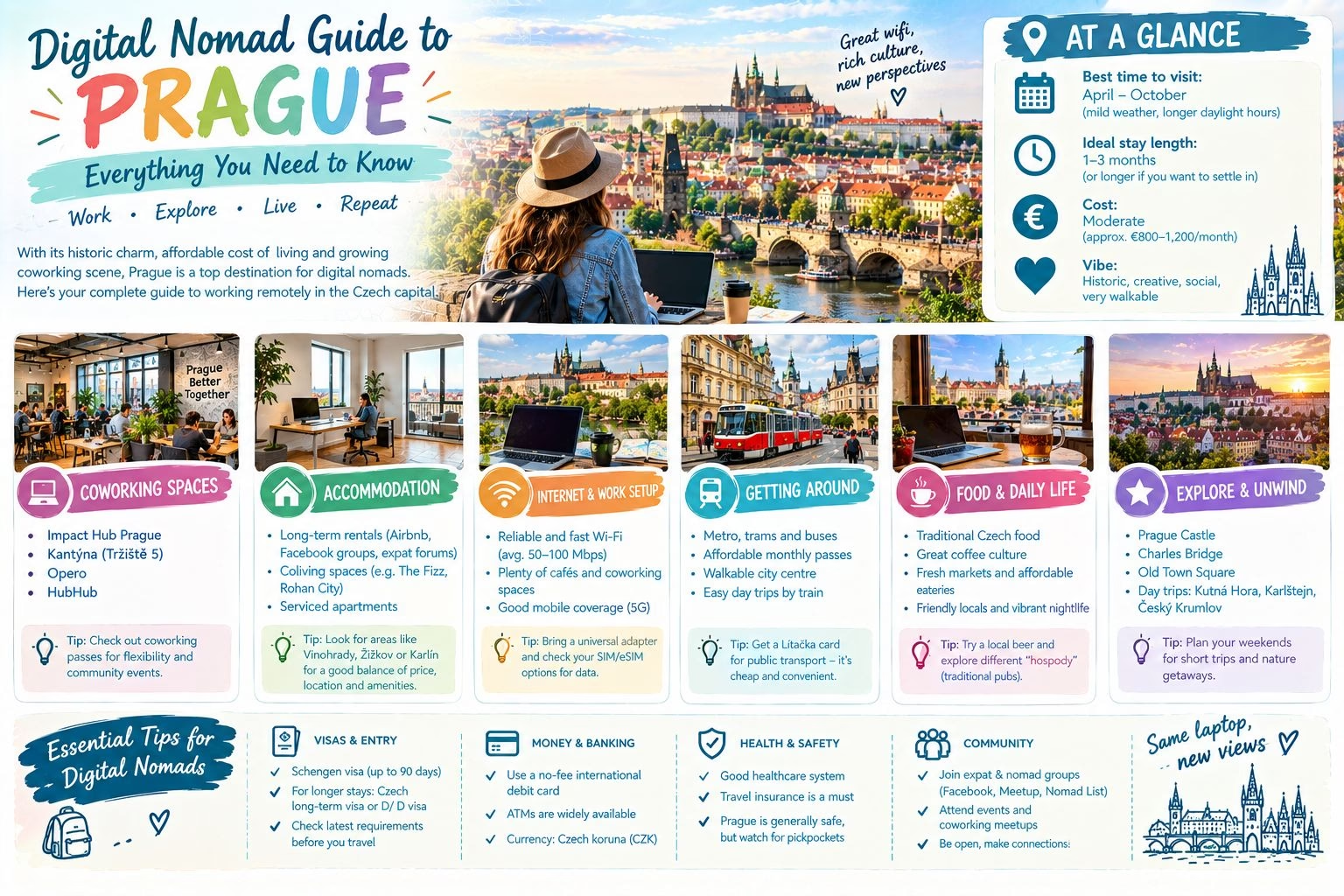
Prague has been a significant digital nomad destination since approximately 2015, and the infrastructure, community, and practical setup for remote workers is now well-developed. The city offers a specific combination of assets: a very good coworking ecosystem, a rich European cultural environment, Central European prices (significantly cheaper than London, Paris, or Amsterdam; roughly comparable to Lisbon on a monthly cost basis), good transport connections to the rest of Europe, and the specific Prague quality of life that produces the famous “why would I leave” effect on longer-term visitors.
Why Prague as a Nomad Base
Cost: Prague is not the cheapest European city for digital nomads (that would be cities in Eastern Europe, the Balkans, or the Baltics), but it offers very good value at a higher quality of life than many cheaper alternatives. Monthly costs for a comfortable lifestyle (apartment in Vinohrady, coworking membership, regular restaurant meals, weekend day trips): CZK 35,000 to 55,000 (approximately EUR 1,400 to 2,200). This compares favourably with London (equivalent lifestyle approximately EUR 4,000 to 5,000), Amsterdam (EUR 3,000 to 4,000), or even Lisbon (EUR 2,000 to 2,800).
Culture and quality of life: Prague’s cultural offer is exceptional by Central European standards and remarkable by European standards: the architecture and heritage, the music and arts scene (the Prague Philharmonia, the Prague Spring Music Festival, the National Theatre opera programme), the restaurant and food culture that has developed significantly since 2010, and the day trip circuit from Prague that provides enormous variety within 3 hours by train or bus.
Central European connectivity: From Prague, you are within 4 hours by train of Vienna, Bratislava, Dresden, and 2.5 hours from Brno. Frankfurt and Berlin are within 4 to 5 hours by IC train. Warsaw, Budapest, and Kraków are within 5 to 6 hours. Prague as a nomad base makes spontaneous weekend trips to these cities straightforward.
Internet and Working Infrastructure
Prague’s internet infrastructure is generally good. The major Czech ISPs (T-Mobile, O2, Vodafone) provide fibre connections to most Prague apartment buildings; speeds of 100 to 500 Mbps are standard in newer buildings and in post-renovation older buildings. Mobile data (SIM card required) is available from T-Mobile and O2 with reasonable data plans; a Czech SIM card for a month (data + calls) costs approximately CZK 300 to 600.
Café wifi: Prague café wifi quality is variable. The dedicated coworking spaces are the reliable option for intensive work sessions; cafés work well for lighter tasks.
Visa Situation for Digital Nomads
EU citizens do not need a visa or work permit to live and work in the Czech Republic. Non-EU digital nomads working for non-Czech companies have more clarity than in most countries: since July 2023, the Czech Republic has run an official Digital Nomad Program, a fast-tracked long-stay visa pathway (not a separate visa category, but a government program that expedites Long-Term Visa applications) aimed specifically at remote workers and freelancers in IT, STEM, or marketing. Eligibility is currently restricted to citizens of Australia, Canada, Japan, New Zealand, South Korea, Taiwan, the UK, and the US, and applicants need either three years of IT experience or a relevant STEM degree, plus proof of income around 1.5 times the Czech average salary (roughly CZK 70,000 a month as of 2026). Nomads outside these eligible nationalities, or outside IT/STEM/marketing, fall back on the standard long-stay visa or trade licence route below.
The practical options for non-EU nomads:
90-day Schengen stays: Work remotely for foreign companies for up to 90 days in any 180-day period. Not technically authorised as “work” in Czech law but tolerated in practice for remote workers with non-Czech clients.
Long-stay visa for freelancers (živnostenský list): Non-EU nationals can obtain a Czech trade licence (živnostenský list) and apply for a long-stay visa on the basis of self-employment. This is the most common long-term path for non-EU nomads. The process is complex; the visa guide covers it in detail.
Where Nomads Actually Work From in Prague
In practice, most nomads settle into a routine that mixes two or three of the coworking options and cafés listed in the coworking guide rather than sticking to one location. The common pattern: a dedicated desk or membership for deep-focus days, rotated with a nearby café for lighter afternoons, and Vinohrady or Karlín as the two neighbourhoods where this mix is easiest to build, since both have a dense cluster of good coworking and café options within walking distance of typical nomad housing.
Related: Expat Hub | Coworking in Prague | Czech Visa and Permits | Cost of Living