
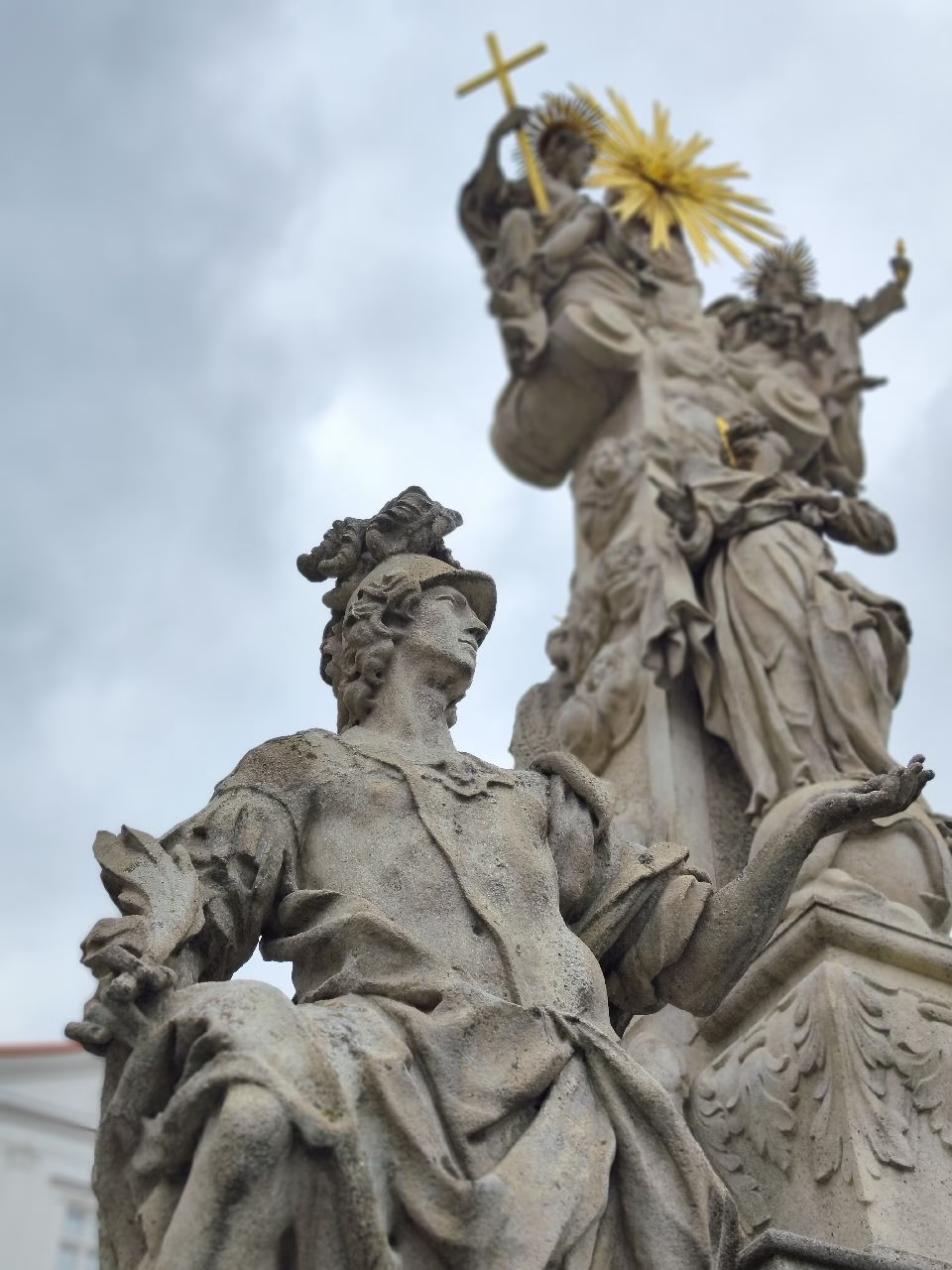
Brno suffers from the fate of all second cities in countries with an overwhelming capital: it exists in Prague’s shadow, is dismissed as a business or conference destination, and is rarely given the independent attention it deserves. This is a mistake. Brno is a genuinely excellent solo travel city, significantly cheaper than Prague, far less crowded, with a strong student population (Masaryk University has 35,000 students) that creates a vibrant cultural and nightlife scene, and a set of specific attractions, Villa Tugendhat, Špilberk Castle, the Labyrinth under the Cabbage Market, that are among the most interesting in the country.
I grew up in Central Europe and have spent time in Brno across many visits. The city reveals itself gradually, which is part of its character: it is not a place that tries to impress you immediately the way Prague does. Give it two days and you will understand why the Brno residents I know are, almost without exception, quietly contemptuous of any suggestion that their city is inferior to the capital.
Is Brno Good for Solo Travellers?
Very much so. The compact city centre is walkable, the tram network is excellent, English is spoken in the tourist areas, and the Brno social environment, relaxed, self-assured, unbothered by the tourist economy that distorts Prague, makes solo travel here comfortable from the first afternoon. The city has a significant international student and expat community, which means venues and restaurants are used to foreign visitors without making a production of it.
The practical case: accommodation in Brno costs 40 to 60 percent less than equivalent accommodation in Prague. Restaurant meals cost proportionally less. The main attractions require far less queuing and advance booking than Prague’s equivalents. For visitors who have already done Prague, Brno offers a genuinely different Czech experience that rewards the extra travel time.
Where to Stay and Explore
The city centre is compact enough that neighbourhood distinctions matter less than in Prague. The area around Náměstí Svobody (Freedom Square, the main square) is the logical base: well connected by tram to everything, central, and with the best concentration of accommodation at various price points. The streets immediately surrounding the square contain the main commercial life of the city.
Stará Brno (Old Brno), southwest of the centre, is the historic neighbourhood with the Augustinian monastery where Gregor Mendel conducted his pea experiments that led to the discovery of genetics. The monastery garden is free to visit and unusually peaceful for a city-centre space.
The area around the Cabbage Market (Zelný trh) is the heart of Brno’s outdoor market and café culture; the market operates on weekday mornings and the square itself has outdoor seating and a consistently pleasant atmosphere in good weather. The entrance to the Labyrinth under the Cabbage Market is here.
Safety
Brno is one of the safest cities in Central Europe for solo travellers. The tourist economy that generates Prague’s specific scam ecosystem does not exist here: there are no unlicensed currency exchange booths targeting tourists, no taxi drivers targeting arrivals with inflated rates, no souvenir strips. Petty theft exists in the way it does in any European city but is not a notable risk by any reasonable comparison.
Solo female travellers will find Brno entirely comfortable. The student culture creates a social environment that is young, international, and in the better nightlife venues, genuinely welcoming. The tram system runs late enough to make getting home straightforward.
Getting Around
Brno’s tram network is excellent and covers the city comprehensively. The central stop is Hlavní nádraží (main station) for connections to Prague (approximately 2.5 hours by fast train, a very comfortable journey worth doing rather than flying). Trams run from early morning to midnight with night buses covering the gaps. The integrated ticket covers trams and buses; buy from the yellow ticket machines at stops or via the DPMB app.
The city centre is easily walkable. The distance from Náměstí Svobody to Špilberk Castle is 15 minutes on foot uphill. From the centre to Villa Tugendhat is 25 minutes walking or 10 minutes by tram. Having a tram app (the IDOS app covers all Czech public transport) makes navigation significantly easier.
What to See and Do
Villa Tugendhat is the reason many architecture and design-focused travellers come to Brno specifically. Designed by Mies van der Rohe and completed in 1930, it is one of the defining buildings of modernist architecture, a UNESCO World Heritage site, and visually extraordinary in a way that photographs do not fully communicate. Entry is by timed guided tour only; book online in advance as the tours sell out weeks ahead. Allow 2 hours including travel from the centre.
Špilberk Castle dominates the city from its hill above the centre. The castle served as a Habsburg prison in the 18th and 19th centuries; the casemates (underground prison cells) are the most visited attraction within it and give the castle a specific, dark historical depth. The views from the castle ramparts over the city are excellent. A full morning is enough.
The Labyrinth under the Cabbage Market (Labyrint pod Zelným trhem) is a medieval underground network of cellars beneath the market square, used for food storage over centuries and partially open to visitors as a museum. Atmospheric, genuinely interesting, and a 45-minute experience that is considerably better than its tourist-attraction status suggests.
The Ossuary under St James Church (Kostnice u sv. Jakuba) was discovered in 2001 and contains the remains of approximately 50,000 people, the second largest ossuary in Europe after Paris. The bones are arranged with the same deliberate aesthetic as the Paris Catacombs, with a quiet dignity that is very different from the ghoulish reputation underground ossuaries sometimes acquire. Open Tuesday to Sunday; buy tickets online.
Gregor Mendel’s pea garden at the Augustinian monastery is a genuinely peaceful free experience; the garden where the laws of heredity were discovered is maintained as a heritage garden with information boards explaining the experiments. A pleasant 30 minutes that most visitors skip entirely.
Practical Tips
Best time to visit: Brno is good year-round. May and June are excellent; the gardens and parks are in full colour and the outdoor market culture reaches its peak. September and October are ideal for the combination of mild weather and the Brno wine harvest season (the South Moravia wine region begins immediately outside the city). December has a Christmas market on Náměstí Svobody that is genuine rather than tourist-oriented.
Food and drink: Brno’s food scene is better than it gets credit for. The restaurants around the Cabbage Market offer Czech classics at much lower prices than Prague equivalents. Brno is also the gateway to the South Moravian wine region; the restaurant wine lists often feature local Moravian wines (Welschriesling, Müller-Thurgau, Blaufränkisch) that are excellent and almost unknown outside the Czech Republic. A glass of Moravian wine at an outdoor table in the Cabbage Market in good weather is one of my favourite experiences in the country.
Day trips: Brno is an excellent base for exploring Moravia. Lednice-Valtice Cultural Landscape (UNESCO, 60km south), Moravian Karst and Macocha Abyss (40km north), Kroměříž Archbishop’s Palace and Gardens (75km east). The train and bus connections are reliable and the distances are manageable in a day.
Getting to Brno: the fast train from Prague (RegioJet or Pendolino express) takes 2h20 and arrives at the central station, five minutes’ walk from the main square. This is the correct way to travel between the two cities.
Further Reading
For the wider Moravian wine region referenced above, see Czech Wine: Moravia’s Wine Regions. For a full day trip itinerary from Prague, see Brno in the Day Trips hub. For expats and nomads weighing Brno against Prague as a base, cost comparisons are covered in the cost of living guide.
Related: Solo Travel Hub | Day Trips: Brno | Beer and Food: Czech Wine | Solo Travel in Prague
Written by Jan Marek, Czech travel writer and Central European expat specialist at allaboutczech.com and allaboutvienna.com.