
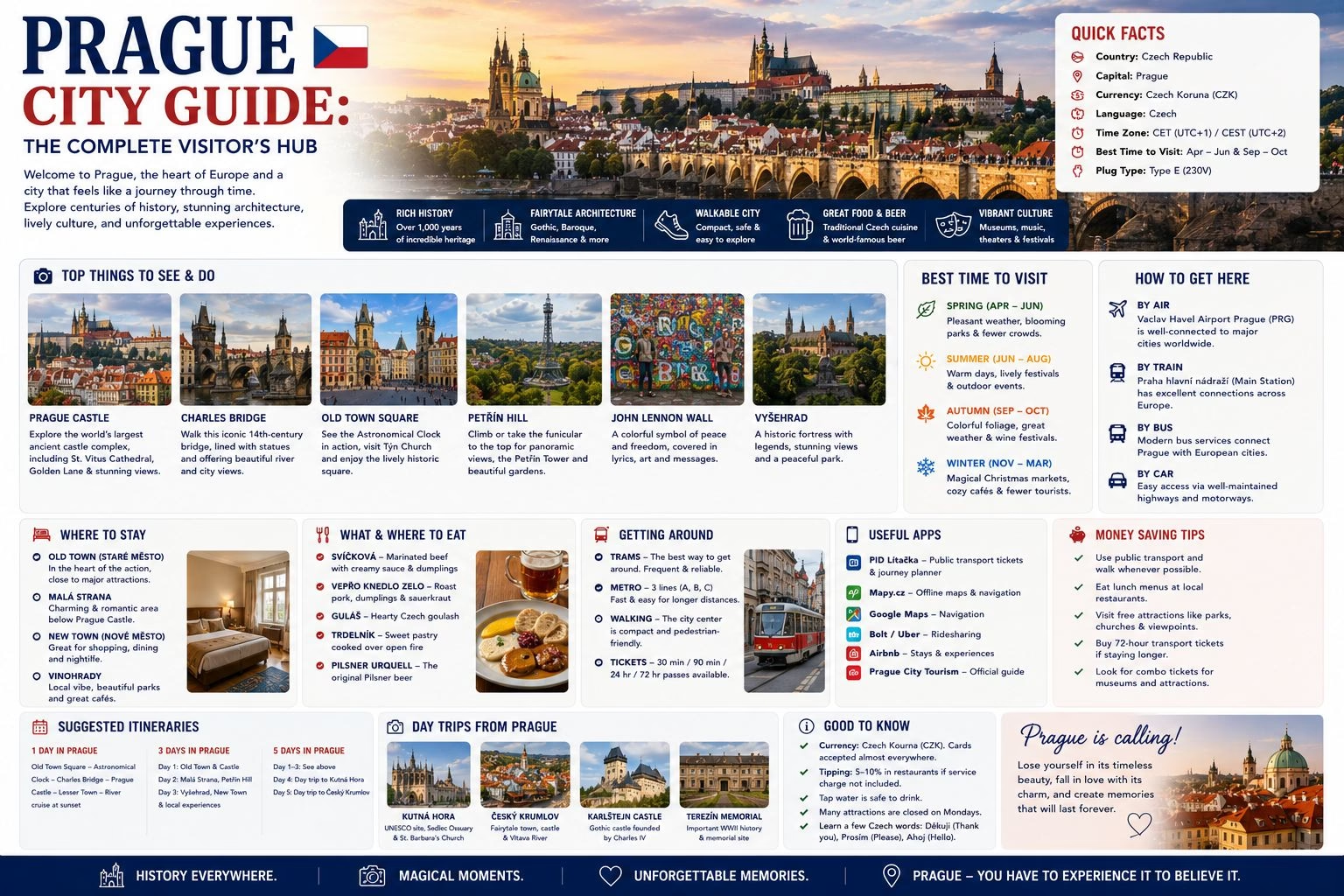
Prague is one of the most architecturally complete medieval and Baroque cities in Europe. Unlike Warsaw, Dresden, or Frankfurt, which were heavily damaged in World War II and subsequently rebuilt, Prague emerged from the 20th century’s conflicts with its historic centre substantially intact: the Gothic spires, the Renaissance arcades, the Baroque palaces and churches, and the Art Nouveau embellishments of the late 19th and early 20th centuries are all present and functioning as they were built. Walking through the Old Town at night, when the tourist crowds have reduced to a tolerable density and the stone lanes are lit by the amber glow of street lamps, is one of the most concentrated architectural experiences available in Europe.
This guide is the hub for everything about Prague: the neighbourhood guides, the activity and attraction coverage, the nightlife, the accommodation, and the transport. If you are planning a Prague visit, start here.
Prague’s Urban Geography: Understanding the City
Prague is divided into numbered city districts, but the historic core that most visitors care about occupies several distinct neighbourhoods with genuinely different characters:
Staré Město (Old Town): The medieval city centre, on the eastern bank of the Vltava. The Old Town Square (Staroměstské náměstí) with the Astronomical Clock is the tourist focal point. Also contains Josefov (the historic Jewish Quarter), the river frontage of Smetanovo nábřeží, and the connection to the Charles Bridge.
Malá Strana (Lesser Town): Below the castle on the western bank. Baroque palaces, embassies, and the winding streets between the bridge and the castle hill. Home to the most beautiful pub gardens in the city and the Church of St Nicholas.
Hradčany: The castle hill and surrounding area. Prague Castle itself plus the cathedral, the palace complex, and the Golden Lane. The highest neighbourhood in the city; the views over the Vltava bend and the red rooftops of Malá Strana are extraordinary.
Nové Město (New Town): Founded in 1348 to expand the overcrowded Old Town; “new” is relative. Contains Wenceslas Square (not actually a square but a broad boulevard), the National Museum, the National Theatre on the riverbank, and most of the city’s main transport connections.
Vinohrady: The prosperous late-19th-century residential neighbourhood east of the New Town. Art Nouveau and Secession apartment buildings, the best neighbourhood café and restaurant scene in Prague, and the largest park within the inner city at Riegrovy sady.
Žižkov: Vinohrady’s eastern neighbour; historically working-class, now gentrifying. The TV Tower, the most discussed piece of contemporary architecture in Prague. The highest pub density of any Prague neighbourhood; traditionally the most affordable inner-city area.
Holešovice: North of the centre on the Vltava bend. Industrial history, contemporary culture (DOX gallery, Vnitroblock design space), the Letná park and its beer garden with the city panorama. The neighbourhood in the process of the Prague gentrification transformation right now.
Neighbourhood Guides
- Old Town and Charles Bridge: the medieval heart and its monuments
- Malá Strana and Prague Castle: below the castle and above the river
- Vinohrady and Žižkov: the neighbourhood for the rest of the visit
- Jewish Quarter (Josefov): synagogues, the old cemetery and memorials
- Petřín and Vyšehrad: quiet hilltop viewpoints
- Museums and galleries: how to choose
- Prague with kids: parks and family sights
What to Do in Prague
The Prague things to do guide covers the full range from the Prague Castle circuit to the Josefov Jewish Quarter, the Vyšehrad fortress, the Letná panorama, and the specific things that visitors should not miss on a first or return visit.
Prague’s Nightlife
Prague has one of Central Europe’s most developed nightlife scenes across multiple formats: the traditional Czech hospoda, the rooftop bar scene (the views over the illuminated city make this specifically rewarding in Prague), the jazz clubs that have operated since the 1970s, and the club scene of the industrial areas. The Prague nightlife guide covers everything from a pint of dark Kozel in a 14th-century cellar to a rooftop cocktail above the Old Town.
Where to Stay in Prague
The Prague accommodation guide covers the neighbourhood choice, the price ranges, and the specific considerations that affect a good Prague accommodation decision. The key insight: staying in Vinohrady instead of the Old Town costs half as much per night and takes 15 minutes by tram to the main sights.
Getting Around Prague
Prague has one of Europe’s best-value public transport systems: trams, metro, and buses on a single integrated ticket valid for 90 minutes across all modes. The Prague transport guide covers the ticket system, the most useful tram routes, the metro connections, and the airport transfer options.
Related: Day Trips | Beer and Food | Practical Info | Plan Your Trip
The Prague Day Trip Context
Prague works as a base for day trips in a way that few European capitals do: the train and bus network radiates out to genuinely extraordinary destinations within 1 to 3 hours, and the return to Prague for the evening is feasible from almost all of them. The Day Trips hub covers the circuit in full; from a Prague city guide perspective, the relevant point is that Prague’s position in the Czech transport network makes day tripping both easy and affordable.
The logistics: most day trips from Prague use Praha hlavní nádraží (the main train station, metro line C) or Praha Florenc (the main bus station, metro lines B and C). Both are in the inner city; reaching either from central accommodation takes 10 to 20 minutes.
Prague’s Population and Urban Scale
Prague is a city of approximately 1.3 million people in the city proper, with the broader metropolitan area reaching approximately 2.6 million. This scale means it is large enough to have the full infrastructure of a major European capital (symphony orchestra, major art museums, international airport, good hospital system) while small enough to be walkable, navigable by bicycle, and compressible into a manageable mental map over a few days.
The historic centre, where most visitors spend most of their time, is small enough to walk across in 30 to 45 minutes; the tram network reaches every part of the inner city. The combination of walkable scale and excellent public transport produces one of the most practical urban environments in Central Europe for both short visits and longer stays.
When Prague Is at Its Best
The question of when Prague is at its best has a complicated answer because it depends on what aspect of the city you prioritise.
Prague is most beautiful at 7am in October: the light is at its annual best quality, the crowds are absent, the chestnut trees along the Vinohrady boulevards are gold and red, and the city has the specific quality of a European capital in the early morning before it is fully awake.
Prague is most socially rewarding in spring and early autumn: the outdoor culture (café terraces, park beer gardens, the Náplavka riverbank) is active, the city is not yet at summer tourist density, and the local populations’ relationship to their public spaces is most visible.
Prague is most atmospheric in December: the Christmas market, the snow when it comes, the illuminated Gothic spires above the market stalls. Arrive before the market reaches maximum December 20 density for the best combination of atmosphere and manageability.
Prague’s International Reputation vs. Its Reality
Prague’s international reputation is built on three pillars: the architecture, the beer, and the relative cheapness compared to Western European capitals. All three are accurate. The reputation underestimates at least two things: the contemporary food and cultural scene that has developed since 2010, and the specific quality of Prague as a lived-in city rather than a tourist backdrop.
The architecture is as extraordinary as the reputation suggests; the medieval and Baroque preservation is genuinely remarkable. The beer is as good as the reputation suggests; a perfectly poured Pilsner Urquell in a traditional pub is a specifically Czech experience that cannot be replicated elsewhere. The cheapness is real but narrowing; Prague is now closer to Vienna in price than it was in 2000, though still significantly cheaper for equivalent quality.
What the reputation underestimates: the Vinohrady café and restaurant scene is genuinely excellent by any European standard, not just by Central European comparison. The contemporary Czech art and design scene, visible at DOX and at the designer markets at Manifesto and Vnitroblock in Holešovice, is interesting and specific. The Czech music scene, from the world-class Prague Philharmonia to the jazz clubs to the independent music venues, is better than most visitors expect.
The Language Situation in Prague
Prague is one of the most English-friendly capital cities in Central Europe. English is widely spoken throughout the tourist infrastructure, in most restaurants and hotels, and increasingly in everyday commerce. The younger generations of Czech service workers speak English as a matter of course; the older generations less so.
The specific situations where Czech language is useful: at traditional pubs, at the foreign police, at administrative offices, and in the smaller shops and services of the outer neighbourhoods. The language basics guide provides the essential phrases.
Solo Travel and Longer Stays in Prague
Prague is also the anchor of two other parts of this site worth knowing about before you arrive. Solo travellers make up a large share of Prague’s international visitors, and the solo travel in Prague guide covers neighbourhood safety, where to base yourself, and how to meet people, in more depth than fits into a general city guide. For visitors staying longer, whether as a digital nomad or a longer-term expat, the Expat and Nomad hub covers cost of living, visas, and coworking, using Prague as the reference point throughout.
Quick Reference: Prague Key Numbers
Public transport single ticket: CZK 50 (90 minutes, 46 in the app); day pass CZK 150 (140 in the app).
Beer at a local pub: CZK 45 to 75.
Daily menu lunch at a local restaurant: CZK 150 to 250.
Prague Castle entry (Ticket B): CZK 250 to 350 depending on option.
Jewish Museum Prague combined ticket: CZK 500.
Airport to city centre by public transport: CZK 50 (trolleybus 59 plus metro), 40 to 50 minutes.
Airport to city centre by Bolt/Uber: CZK 400 to 600, 25 to 40 minutes.
Emergency numbers: police 158; medical 155; EU emergency 112.
Related: Solo Travel in Prague | Expat and Nomad Hub | Day Trips | Beer and Food | Practical Info | Plan Your Trip