
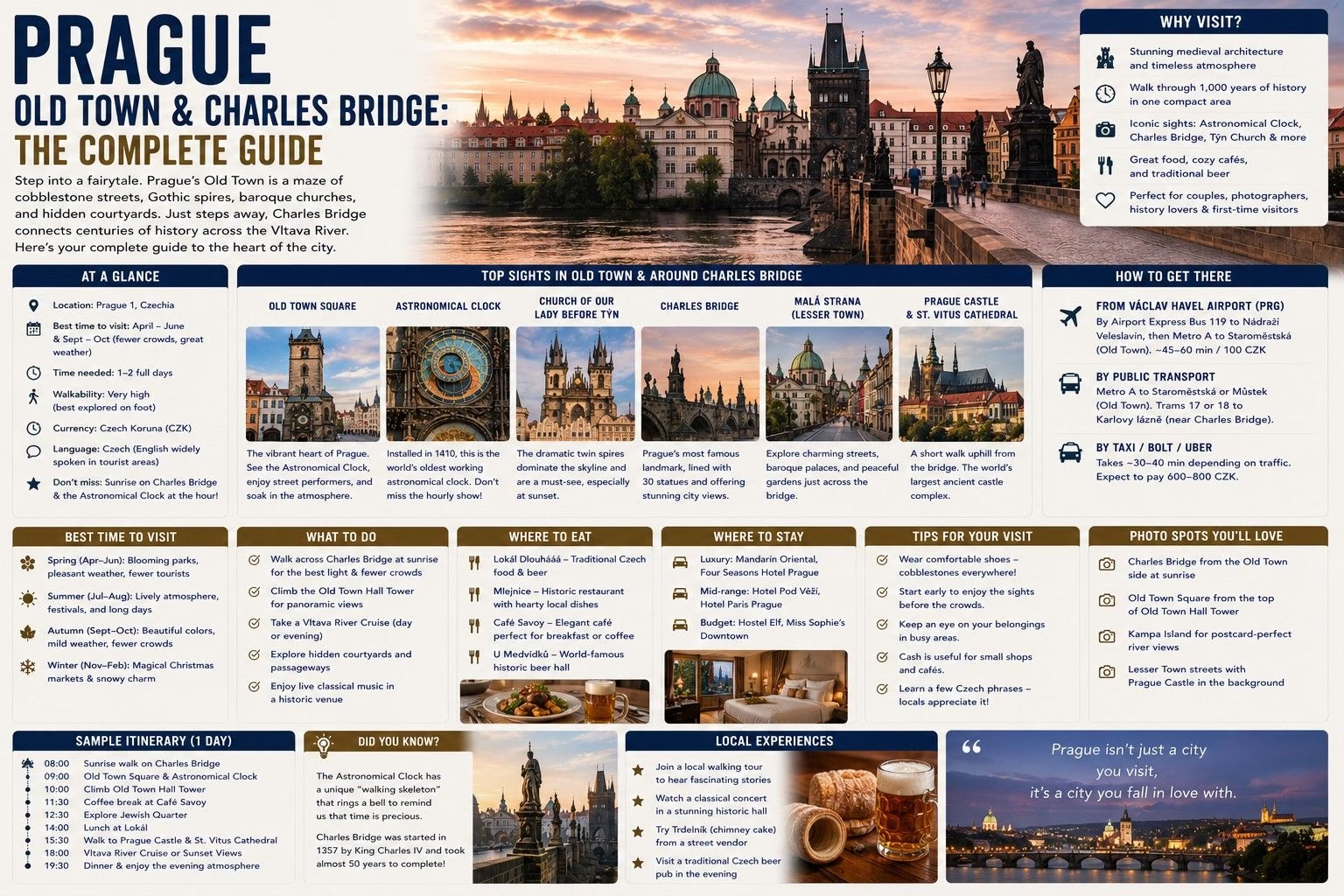
The Old Town (Staré Město) is the historical nucleus of Prague and the neighbourhood that generates the city’s international reputation. It contains the most famous concentrated collection of Gothic and Baroque architecture in Central Europe, the most visited monument in the Czech Republic (the Astronomical Clock), and, in summer, the highest tourist density of any equivalent district in Europe. Understanding how to engage with it, when to visit specific sites, and how to move beyond the core tourist circuit produces a genuinely rewarding Old Town experience rather than a crowded one.
The Old Town Square (Staroměstské náměstí)
The Old Town Square is the physical and symbolic heart of Prague. Founded in the 10th century as a market square, it has served as the site of executions, protests, coronations, and celebrations for a thousand years. The square is surrounded on all sides by buildings of different architectural periods: the Romanesque elements of the Old Town Hall tower (which dates from 1338), the Gothic towers of the Týn Church, the Baroque St Nicholas Church, the Renaissance Kinský Palace, and the 19th-century neo-Gothic extension of the Old Town Hall.
The Jan Hus Memorial in the centre of the square, unveiled in 1915, marks the 500th anniversary of the Czech religious reformer’s execution. The memorial is worth pausing at: Hus’s execution in 1415 and the subsequent Hussite Wars shaped the Czech religious and national character in ways that persist in the current culture of scepticism toward institutional authority.
The Astronomical Clock (Orloj)
The Astronomical Clock on the south face of the Old Town Hall tower was installed in 1410 and has been functioning, with repairs and restorations, for more than 600 years. The clock has three sections: the astronomical dial (showing the position of the sun, moon, and the 12 signs of the zodiac), the calendar dial below it (showing the day and saint’s day), and the hourly performance mechanism above.
The hourly performance (running from 9am to 11pm): a skeleton pulls a cord, Death’s hourglass tips, the Apostles process in two windows above the clock face, and a cock crows to signal the end. The performance takes approximately 45 seconds. It is the most photographed moment in Prague; the crowd in the square for the hour strikes can be very large in summer. From an architectural and mechanical history perspective, the astronomical dial is more interesting than the performance: it is one of the oldest functioning astronomical clocks in the world.
The tower interior is accessible by lift; the view from the top is excellent and the crowds are lower than the castle’s viewpoints.
The Jewish Quarter (Josefov)
The Josefov, occupying several blocks northwest of the Old Town Square, was the historic Jewish ghetto of Prague from the late 10th century until the ghetto’s formal abolition in 1848. The buildings that survive are the six historic synagogues and the Old Jewish Cemetery; everything else was demolished in the 1890s urban clearance and replaced with the Art Nouveau apartment buildings visible today.
The Jewish Museum Prague (Židovské muzeum v Praze) administers the site. A combined ticket (approximately CZK 500; advance booking recommended in summer) covers all the main sites:
Pinkas Synagogue: The second-oldest surviving synagogue in Prague (16th century), whose interior walls are inscribed with the names of 80,000 Bohemian and Moravian Jewish victims of the Holocaust. One of the most powerful memorial spaces in Europe; allow adequate time.
Old Jewish Cemetery: The largest surviving medieval Jewish cemetery in Europe, with approximately 12,000 gravestones above ground and an estimated 100,000 burials in layers over more than five centuries. The density of the gravestones, piled one against another as the available space diminished, is visually extraordinary.
Spanish Synagogue: The most architecturally striking of the synagogues; an ornate Moorish Revival interior from the 1860s with gilded detailing throughout.
Maisel Synagogue: The history of Jews in Bohemia from the 10th to the 18th centuries, presented in the synagogue built for Mordecai Maisel, the mayor of the ghetto and financier to Emperor Rudolf II.
The Charles Bridge (Karlův Most)
The Charles Bridge, completed in 1402, is the most photographed structure in Prague and one of the most photographed structures in Europe. The 516-metre Gothic bridge crosses the Vltava between the Old Town and Malá Strana; its 30 Baroque statues (primarily from the 17th and 18th centuries; the originals are now in the Lapidarium museum, replaced by copies) give it a distinctive visual character.
The bridge is most rewarding at the margins of the day. At 7am on a summer morning, the bridge has early morning light, thin mist possible over the river, and very few visitors. At 2pm in July, it is impassable with tourist density. The practical strategy: cross the bridge early in the morning toward the castle (when the light is best on the Old Town side) and return in the evening for the lit view from the Old Town end.
Beyond the Main Circuit: The Old Town Worth Exploring
The Old Town away from the tourist axis repays walking. The streets between the Týn Church and the Vltava riverfront, particularly Celetná and Týnská, have less tourist density and more characteristic architecture. Bethlehem Square (Betlémské náměstí) and the Bethlehem Chapel, where Jan Hus preached in the early 15th century, is a specific historical site that sees very few foreign visitors relative to its significance.
The riverfront itself, from the bridge north to Čechův most, provides the view of the Old Town from across the water that produces the skyline photographs. The most photographed view of Prague is from the bridge looking northeast, with the towers of the Týn Church and the Old Town Hall above the river.
How Much Time to Allow in the Old Town
Most visitors underestimate the Old Town and end up rushing Malá Strana or Vinohrady as a result. A realistic minimum is half a day: about two hours for the Old Town Square, the Astronomical Clock, and the streets immediately around it; ninety minutes for the Jewish Quarter if you go inside the synagogues rather than just walking past them; and thirty minutes to cross the Charles Bridge without hurrying. Visitors with a single day in Prague should treat the Old Town as the morning and early afternoon block, then move to Malá Strana and the castle for the late afternoon light. Two full days allows for the early morning return visit recommended above, plus a slower pass through the Jewish Quarter on a quiet weekday morning.
Related: Solo Travel in Prague | Plan: How Many Days in the Czech Republic | Practical Info: Scams and Tourist Traps