
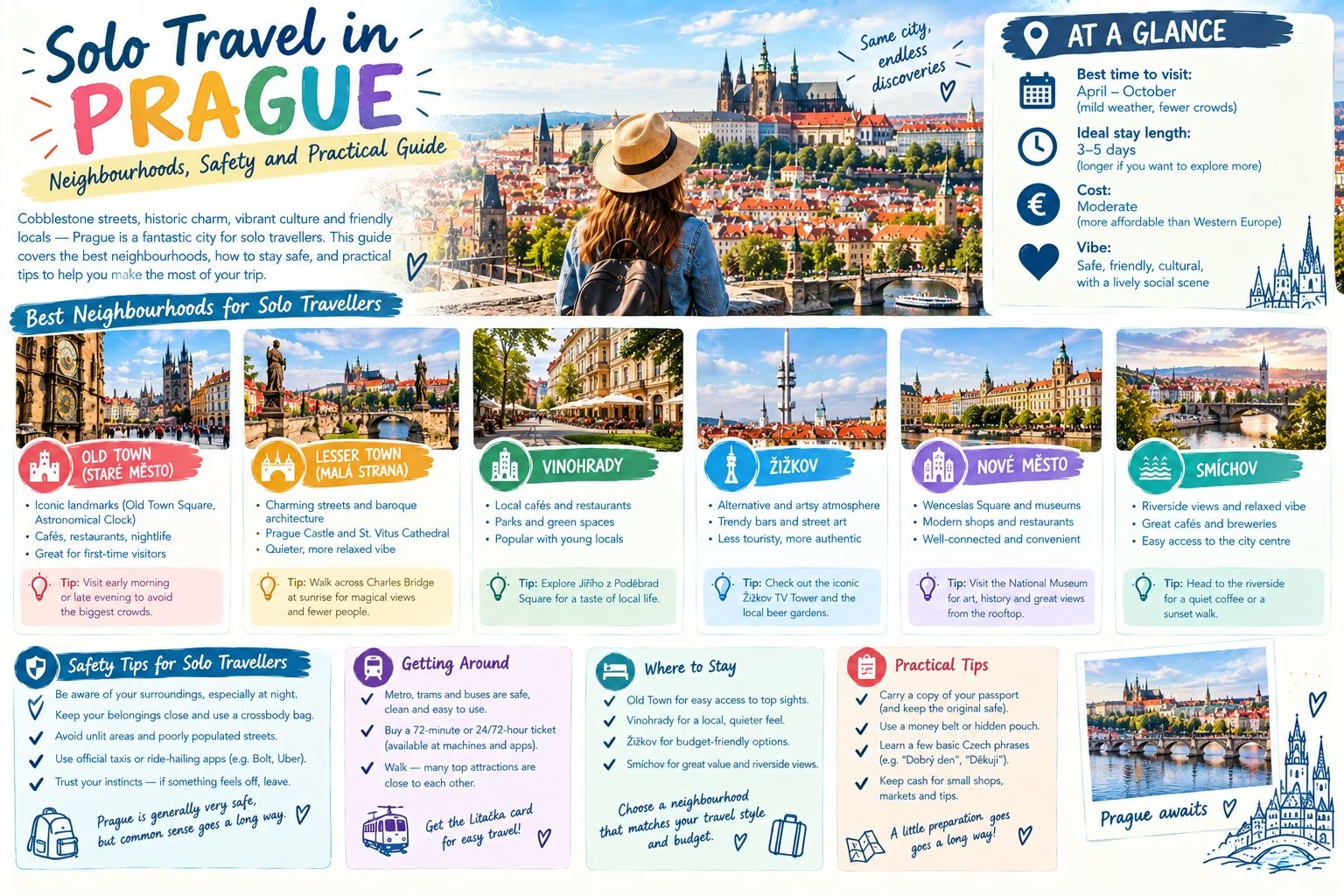
Prague is one of the most beautiful cities in Europe and one of the most heavily visited, a combination that creates both extraordinary experiences and specific challenges for solo travellers who want to see the city rather than just its tourist surface. The old town, Charles Bridge, Prague Castle: these are genuinely magnificent and worth every moment of your time. They are also surrounded by an infrastructure built to extract money from visitors, and navigating around that infrastructure is the skill that separates a good Prague trip from an expensive, frustrating one.
I am Czech, and I have watched Prague change over the twenty years I have been writing about Central Europe. The city I know, the residential neighbourhoods beyond the tourist circuit, the local pubs where a half-litre of Czech beer costs a fraction of what it does on the Old Town Square, the metro at 7am when it belongs to commuters rather than tourists, is accessible to solo visitors who arrive with some prior knowledge. This guide provides that knowledge.
Is Prague Good for Solo Travellers?
Exceptionally, with one qualification: Prague has developed a sophisticated tourist economy that operates in parallel with the real city, and the two are sometimes difficult to distinguish on a first visit. The tourist economy, the horse-drawn carriages, the overpriced restaurants on the Old Town Square, the unlicensed currency exchange booths with their misleading rates, the strip of souvenir shops that have replaced every independent business on Celetná Street, is entirely avoidable once you know what to look for. The real Prague is ten minutes’ walk from any of these things and considerably better in every respect.
Practically: Prague is safe, walkable, has an excellent metro system, and is significantly cheaper than Vienna, Munich or Berlin for accommodation and food once you leave the tourist circuit. English is widely spoken in the centre. The city rewards solo visitors who explore beyond the Old Town, Vinohrady, Žižkov, Holešovice, Nusle, in ways that group travellers rarely discover.
Best Neighbourhoods for Solo Travellers
Vinohrady is the neighbourhood I recommend most consistently for solo visitors. It is a residential district of late-19th-century apartment buildings immediately east of the centre, with excellent independent restaurants and wine bars, the best coffee shop scene in Prague, and a social environment that is local and mixed rather than tourist-oriented. It is 15 minutes on the metro from the Old Town and feels like a different city. The streets around Náměstí Míru and Mánesova Street have the highest density of good cafes and restaurants. Accommodation is good value and plentiful.
Žižkov, north of Vinohrady, is Prague’s most bohemian neighbourhood, historically working class, now creative and deliberately resistant to gentrification. The highest density of pubs per capita in Europe is a claim made here with some regularity, and the atmosphere of the local hospody (pubs) is distinctly different from the beer halls around Wenceslas Square. The Žižkov TV Tower (with its famous crawling baby sculptures by David Černý) is here. Rougher around the edges than Vinohrady but full of character. Very comfortable for solo travellers who like cities with some friction.
Holešovice, across the river in the north of the city, is Prague’s most rapidly evolving neighbourhood, former industrial, now home to the DOX contemporary art centre, the Prague Market (Pražská Tržnice), the best street food market in the city, and an increasing number of restaurants and bars that are genuinely excellent. The metro (Vltavská, Line C) connects it to the centre in eight minutes. Worth a dedicated day and increasingly worth staying in.
The Old Town (Staré Město) is essential to see and poor to base yourself in unless budget is completely secondary; it is the most expensive neighbourhood in the city and the most tourist-saturated. Walk every inch of it; spend your evenings elsewhere.
Safety in Prague
Prague is a safe city for solo travellers with two specific risk areas worth knowing. The first is pickpocketing, concentrated on Charles Bridge, in the crowds around the Astronomical Clock, on the trams serving tourist routes (particularly Tram 22 between the centre and the Castle), and in the metro at rush hour. Keep bags in front, phones in zipped pockets, standard urban awareness, applied consistently.
The second is the tourist economy scam ecosystem: unlicensed currency exchange booths that advertise a good rate and apply hidden fees; taxi drivers near the main tourist sites who charge multiples of the metered rate; ‘helpful’ locals who guide you to restaurants with tourist-price menus. The practical countermeasures: use a bank ATM or Revolut/Wise for currency, use Bolt or Uber for taxis, and choose restaurants by walking one street further than the main tourist drag rather than trusting recommendations from strangers.
Solo female travellers will find Prague comfortable in the residential neighbourhoods. The tourist nightlife areas, particularly Wenceslas Square and its side streets, operate a different kind of economy late at night and are best avoided after midnight unless you know specifically where you are going.
Getting Around
Prague’s metro has three lines (A, B, C) covering the most important tourist and residential areas. The integrated transport ticket covers the metro, trams and buses within a time window; the 24-hour and 72-hour passes are excellent value for visitors. Trams are the secondary system and cover areas the metro doesn’t reach; Tram 22 is the classic sightseeing tram route (and also the classic pickpocket route, be aware). The metro runs from approximately 5am to midnight.
Walking connects everything in the historical centre. The distance from the Old Town Square to Charles Bridge is seven minutes on foot. From the National Theatre to Wenceslas Square is ten minutes. Prague’s hills make some routes more demanding than the map suggests; the Castle district is significantly uphill from the river, which matters on a hot day with luggage.
Václav Havel Airport is connected to the centre by bus (lines 119 and 100, changing at the metro at Nádraží Veleslavín or Zličín); there is no rail connection. The bus takes 30 to 45 minutes to the centre. Bolt and Uber operate from the airport at fixed rates significantly lower than the unofficial taxi drivers who approach you in the arrivals hall.
What to Do as a Solo Traveller
Prague Castle complex (Pražský hrad) earns its reputation as the largest castle complex in the world. The compound contains St Vitus Cathedral, the Royal Palace, the Basilica of St George, the Golden Lane (Franz Kafka’s house is on this street), and views over the entire city. Allow a full morning. Buy the combined ticket at the ticket office rather than just paying for entry to the grounds (the grounds are free; the buildings require a ticket). Go early: by 10am the coach tour groups arrive and the Cathedral in particular becomes very crowded.
The Jewish Quarter (Josefov) is one of the most significant Jewish heritage sites in Central Europe: six historic synagogues, the Old Jewish Cemetery (where graves are stacked in layers due to space constraints, creating an otherworldly density), and the Jewish Town Hall. It requires a separate ticket from the Castle and is worth several hours. Go on a weekday morning for the quietest experience.
Charles Bridge is at its best at dawn, before the souvenir sellers set up and before the tourist stream begins. At 7am in the summer you can walk across with almost no one else there and the city looks like a different century. At 11am it is a crowd-navigation exercise. Both experiences are valid Prague experiences; the early one is considerably better.
Letná Park, above the river on the north bank, has the best city view in Prague; the beer garden at Letná (Letenský zámeček) overlooks the bend in the Vltava with the bridges and Old Town spires below. Free, accessible by a short uphill walk from the metro, excellent for an afternoon hour with a Czech beer. Far fewer tourists than any equivalent viewpoint.
Practical Tips
Best time to visit: May, early June, September and October. Prague in July and August is hot and extremely crowded; the city functions but the tourist areas are at their most overwhelmed. December is magical (Christmas markets on the Old Town Square and Wenceslas Square are among the best in Central Europe) but very cold and very expensive. The shoulder seasons offer the best balance of weather, atmosphere and manageable crowds.
Czech beer culture: Prague is one of the great beer cities in the world and a solo traveller has no disadvantage in the pub environment; sitting alone at a pub table, ordering a Pilsner Urquell or Kozel dark, is entirely normal and unremarkable. The local hospoda is the correct venue: find one in Vinohrady or Žižkov, sit down, a half-litre will arrive. The price will be a fraction of the Old Town rate. This is how Prague actually works.
Currency: the Czech Republic uses the Czech koruna (CZK), not the euro. Do not exchange money at the booths on the tourist routes; use a bank ATM (Česká spořitelna and Komerční banka are reliable) or a multi-currency card like Revolut. The airport exchange booths and Old Town currency exchange offices frequently charge 10 to 15 percent hidden commissions.
Language: Czech is genuinely difficult and most visitors make no attempt to learn any of it. A few words (dobrý den, good day; prosím, please; děkuji, thank you; kde je…?, where is…?) make a noticeable positive difference in interactions, particularly outside the tourist areas. Czechs appreciate the effort more than most Central European cultures.
Further Reading
This guide covers Prague specifically; for the neighbourhood detail on Vinohrady, Žižkov, and Malá Strana, see the Prague hub. For day trips that work well from a solo base in Prague, see the Day Trips hub, particularly Český Krumlov, which also has its own solo travel guide. For the pub culture referenced throughout this guide, see Czech Pub Culture and Etiquette.
Related: Solo Travel Hub | Prague Hub | Practical Info: Safety | Solo Travel in Český Krumlov | Solo Travel in Brno
Written by Jan Marek, Czech travel writer and Central European expat specialist at allaboutczech.com and allaboutvienna.com.